Hot Tires, Light Bars and a Showroom Floor That Holds Up
Two things decide whether a showroom floor still looks right in a year: what hot tires do to it every afternoon, and how flat it reads under the lights overhead.
Most owners plan the lights and the wall color for a car showroom long before they think about the slab. Then the first cars roll in off a hot lot and the first photos come back, and the floor turns out to be doing half the work. A deep metallic picks up the light rig and doubles it. A floor that lifts under a tire or ripples under a light bar drags the car down with it. Johnny gets asked about showrooms because both problems are easy to prevent and hard to fix later. Swirl marks, dust on dark colors and old slab prep get their own section on the Ceres showroom flooring page.
Reflections are part of the display
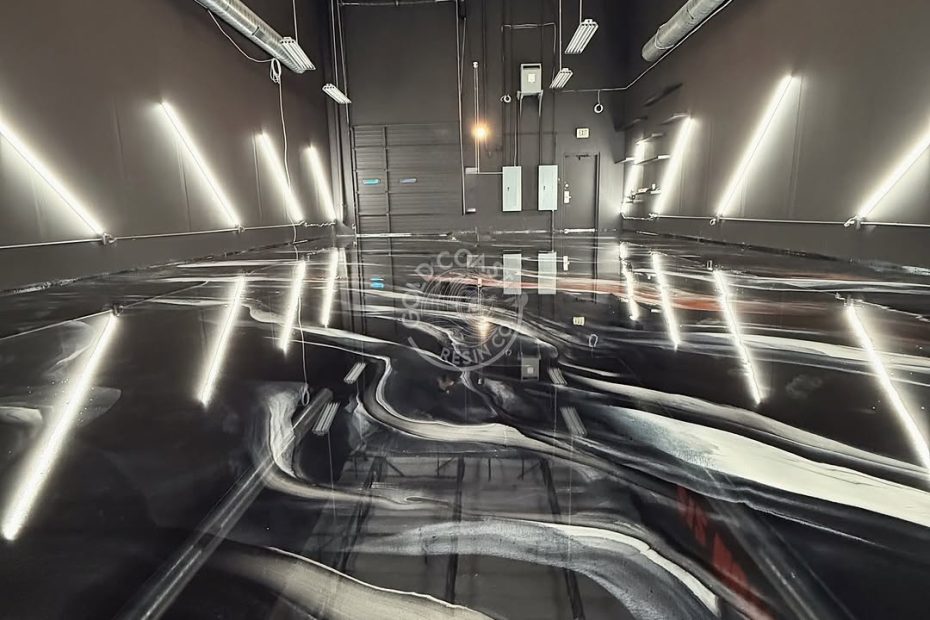
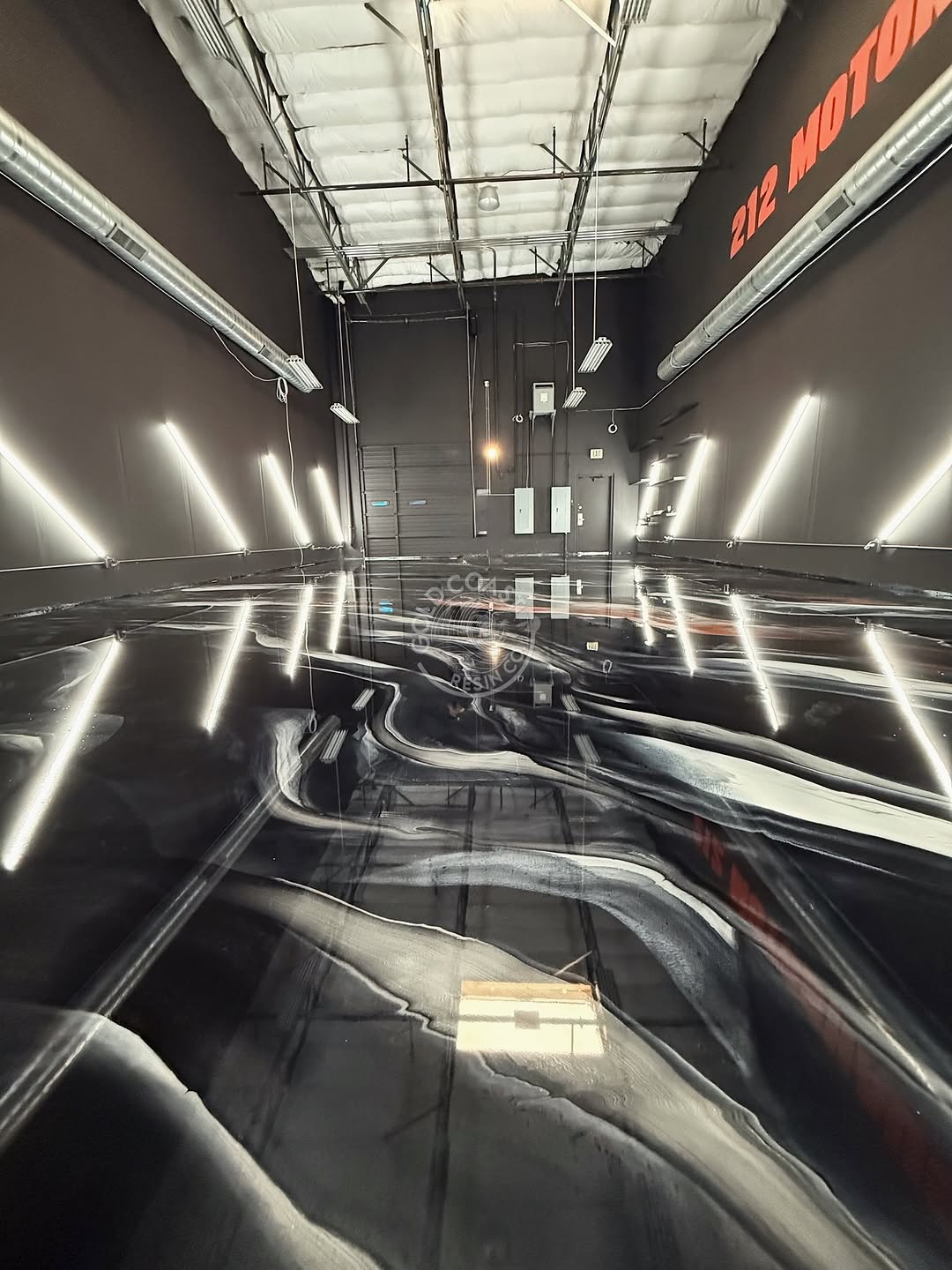
A gloss metallic acts a little like a dark mirror. Light bars on the ceiling show up again on the floor, and a car parked on it gets a soft reflection under the body. That is the effect owners are paying for, and it depends on a clear topcoat with real depth over a color that suits the lights.
Black with white or copper veins makes LED strips pop, since the dark ground gives the reflections something to stand out against. Silver and pearl brighten a room with weaker lighting but show the light bars more softly. Angled bars read differently from straight rows, too. A pattern of diagonal reflections across a veined floor can look busy if the veins run the same direction.
Johnny sets samples under the actual fixtures, at the angle a customer walking in will see them. A color that looks right under a shop light can go flat under cool LEDs, and the only way to know is to look at it in the room.
How cars come in off summer asphalt
A car that sits on a lot through a Valley afternoon soaks up heat from the pavement below and the sun above. Its tires come off that asphalt hot and a little soft. Drive it straight inside and park it, and the rubber settles onto the floor while it is still warm.
The first few minutes are when the tire grips hardest. As it cools it shrinks slightly and pulls at whatever it is stuck to. Turn the wheel while parked and the tread scrubs the floor too. Showrooms that rotate cars from the lot every few days put the same handful of display spots through that cycle over and over.
A few habits help. Let a car that has been in the sun cool in the shade or the drive aisle for a bit before it goes onto a display spot. Avoid turning the wheel while the car is standing still. Move cars on the cooler end of the day when you can. None of that replaces a floor built for it, but it takes some of the load off.
Why some floors let go under a hot tire
On a cheap urethane or a thin epoxy, the pull of a cooling tire lifts the coating right off the slab in the shape of a tread. Owners call it tire pickup, and once it starts it keeps happening in the same parking spots.
The answer is in two places. The first is bond, which comes from grinding the slab to a CSP 2 or CSP 3 profile and priming it properly, so the coating is locked into the concrete instead of resting on a sealed surface. A tire can only lift a coating that was never really attached.
The second is the topcoat. A polyaspartic finish takes hot tire contact without softening the way a cheap urethane does after one Valley summer, and it holds its color under the sun that comes through big front windows. If cars move in and out every day, that topcoat is the part of the floor you want Johnny to talk you into.
Tire marks or real lifting
Not every dark spot under a tire means the floor is failing. Most of the time it is a tire mark: a thin film of rubber left on top of the topcoat, especially from performance tires or a car that sat long on a hot lot. It looks alarming on a light floor and comes up with a cleaner and a soft brush.
Real lifting looks different. There is a raised edge you can feel, a bubble, or a patch where the gloss and color are simply gone and the surface feels rough. Sometimes the mark matches the tread pattern exactly, with bare concrete showing in the grooves.
The difference matters because the fixes are nothing alike. A tire mark is a cleaning job. Lifting means the bond under that spot has failed, and the area has to be cut back to sound coating, reground and rebuilt before the next car parks there. If you are not sure which one you are looking at, send Johnny a photo.
How level reads under light bars
Light bars are unforgiving. A straight bar reflected in a gloss floor should look straight. Over a low spot it bends, and over a ridge it breaks into a kink. Customers may not know why the floor looks off, but they notice.
That puts the work into the grinding. On a showroom, Johnny takes the high spots down, fills the dips and checks how the slab reads under a work light held low before any color goes on. Old trowel marks, patched trenches and slight humps at joints all show up when light crosses them at an angle, and every one of them is easier to correct in bare concrete than to hide under a coating.
The coating helps, since a self-leveling metallic flows into small irregularities. It cannot fix a slab that is out of plane. Getting the reflection right is mostly done before the first bucket opens.
Questions showroom owners ask
How soon can cars go back on the floor?
Walking on it is usually fine the next morning, and vehicles go back in at seventy two hours in most cases. Heat, humidity and the system you pick can move that number. Johnny tells you the real timing before the job starts, so you can plan where the inventory sits while the floor cures.
How can I tell a tire mark from a coating that is failing?
A tire mark sits on top. It is a dark smudge that comes up with a cleaner and a soft brush, and the gloss underneath is fine. Lifting shows as a raised edge, a bubble or a patch where the floor feels rough or the color is gone. If a fingernail catches an edge, call Johnny before the next car parks there.
Should the light bars go up before or after the floor?
Before, if you can manage it. Lifts and ladders are hard on a new floor, and having the real lights in place lets Johnny check the slab and the samples under them. If the lights have to come later, the floor gets covered while the install crew works, and nobody rolls a lift across it without protection.
Gold Coast Resin works out of Hollister and coats commercial floors in Ceres. See the Ceres page, browse our metallic floors, ask Johnny to bring samples under your lights, or call (650) 797-3040. Parking a few of those cars at home? The garage coatings page covers the same hot tire problem in a house.
Put a sample under your light bars
Johnny checks the slab for level and bond, then sets samples where the cars will sit. The visit is a free site assessment.
Call (650) 797-3040