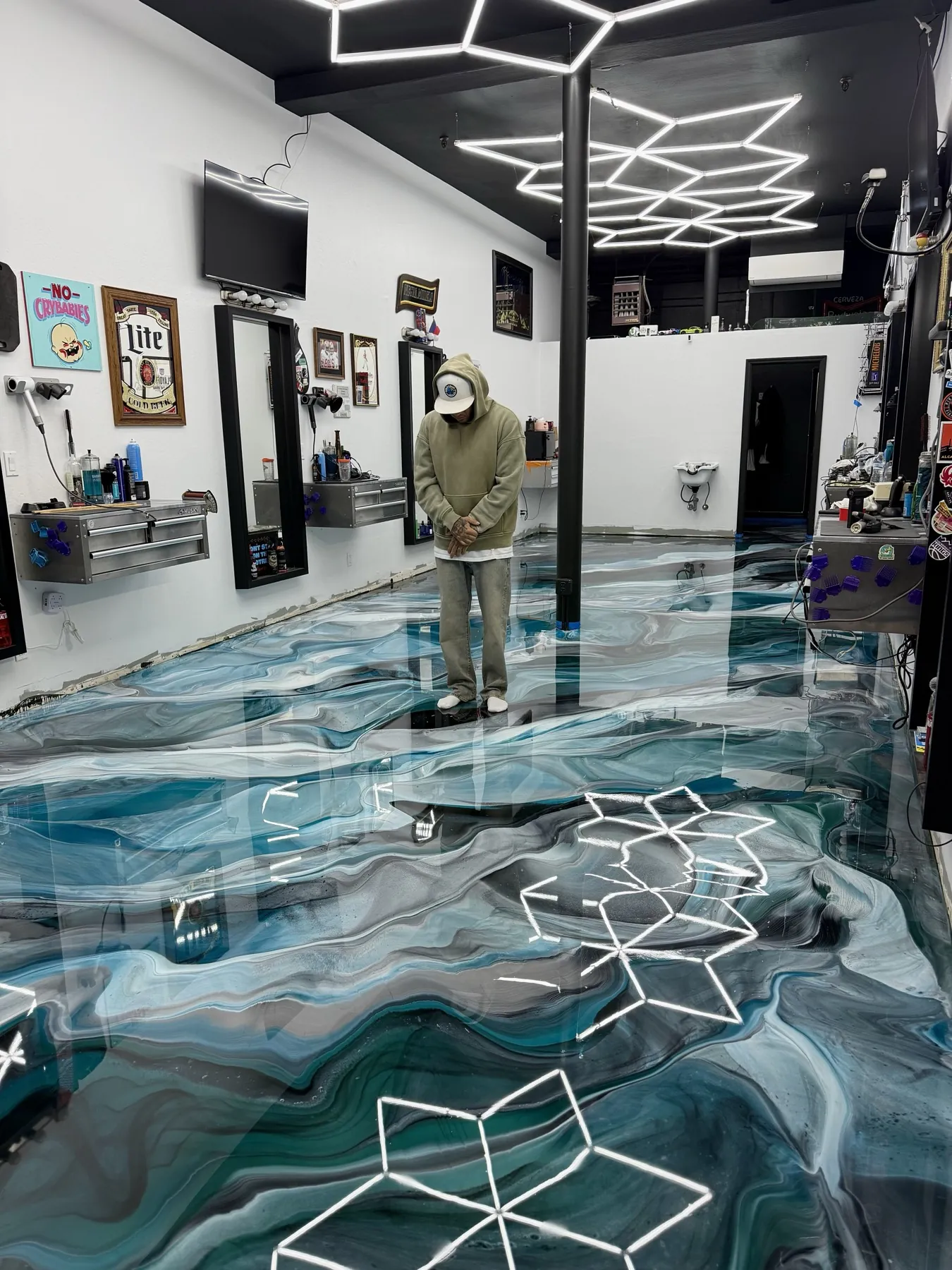
San Juan Bautista Barbershop Floors That Sweep Clean at Close
Clipped hair works its way into every grout line, crack and chip in a shop floor and stays there. A coated floor gives it nowhere to settle, so a broom or a dust mop clears a station in one pass. Johnny Mendoza plans the work around your chairs, your stools and the days the doors are already shut.
JP Resin Certified · Don Resin Certified · Our Shop Is in Hollister
What every chair throws at the floor
A barbershop is a small room with an unusual mix of wear, and nearly all of it happens within arm’s reach of a chair.
Clipped hair
Fine hair packs into texture, grout and cracks, then holds grime and smell. A smooth, continuous coating with a satin or gloss clear lets it sweep up whole. Grit stays light around the chairs, just enough for footing when a spray bottle drips.
Rolling stools
Small hard casters run the same arc around each chair all day, and over time they wear a groove through a soft finish. A harder topcoat at full thickness around the stations takes that circular traffic without dulling into a ring.
Color and product
Hair dye, pomade, styling spray and oil all end up on the floor near the chairs. Dye is the stubborn one. A sealed clear keeps pigment sitting on top where it wipes off, so it never soaks into bare concrete or the gaps between tiles.
Disinfectant
Jar disinfectant and tool sprays drip, splash and get wiped up many times a day. Johnny asks which products you use so the topcoat is matched to them and does not haze or soften in a ring around each station.
Bolted chairs and how the floor gets under them
Barber chairs are heavy, and most are bolted through a round base plate into the slab. That leaves two ways to handle the floor. One is to unbolt every chair, coat the whole room as one continuous surface and reset the chairs on new anchors. It gives the cleanest result, with no edge at any station for hair and dust to pack against.
The other is to coat around the bases. It is quicker and avoids disturbing water lines or wiring that may feed a station, but it leaves a ring at each chair. Johnny cuts that edge clean and seals it so the coating cannot start lifting there, and he will tell you which approach suits your shop and your timeline.
If the chairs do come up, it is a good moment to deal with the anchor holes. Old ones get filled and ground flush, and new holes are drilled through the cured coating and sealed, so mop water cannot wick down around the bolts.
The cleanest shop floor runs right under the chairs. When a chair has to stay put, the ring around its base gets sealed like a joint.
Hydraulic chairs can weep a little fluid at the base over the years. That spot gets degreased and ground like any other contaminated patch before coating, so the new floor grips there as well as it does everywhere else in the room.
Rolling stools, carts and the front desk chair are the easy part. They go out for the night and come back once the topcoat is ready for traffic. The waiting area and the entry get a little more grit in the clear than the stations do, since that is where customers step in off the sidewalk with wet shoes.
A one-room shop that cannot go dark for a week
A small shop downtown is usually a single room with a back area, run by people who lose a day of income for every day the doors stay shut. A floor job that drags across a week is off the table. So the work is booked for nights and for the days you close anyway.
On a typical small shop, grinding and the base coats start as soon as the last client walks out. The decorative layer and the clear follow, and a fast-return topcoat often lets the chairs go back in by the next morning or after a single closed day. Johnny maps the sequence for your room before anything is booked, so you know exactly when you can reopen.
Water from the shampoo bowl and the color station runs to the same low corners every day. Those edges get sealed, and where it makes sense the coating turns up the wall a short way so a splash never finds raw concrete.
Tourist weekends are the busiest stretch on the street, and those stay off limits.
Book the floor around the appointment book. Doing it the other way around costs you regulars.
Patched concrete first, then a floor in your colors
Behind a lot of these storefronts the concrete has been poured in pieces and patched wherever a wall shifted or a trench went through for a pipe. Johnny checks the floor for hollow spots, grinds down to sound concrete, and fills or replaces the weak sections before any coat goes down. Old paint or sealer from a past tenant comes off completely, because anything loose will lift the new floor right along with it.
Old patches also tend to leave a lip or a low spot. The worst of it gets leveled with patching compound before the first coat, so stools do not drift toward one corner and the finished surface reads flat under the station lights.
Then comes the part owners enjoy. In a small room the floor is the biggest surface you have, and it can carry the look of the shop. A metallic in your colors, a darker band under the stations or a simple inlay near the door all go in during the coating, under the clear, so they wear along with the floor.
Johnny puts samples down on your own slab so you can judge them in your light at a few times of day before choosing. A color that looks right under shop lights at night can read differently with afternoon sun coming through the front window.
Systems and finishes for shops are covered in more detail on our barbershop flooring page.
Barbers’ questions before booking
Will clipped hair cling to a coated floor?
Far less than it clings to grout lines or worn vinyl. A continuous coating with a smooth clear lets hair sweep up in one pass, and the grit near the chairs is kept light so fine clippings have nothing to catch on. A damp mop at close picks up what the broom leaves.
Do the barber chairs have to come out?
Not always. Unbolting them lets the coating run under each chair with no edge, which cleans best. If plumbing or wiring at a station makes that awkward, the floor is coated around each base and the edge gets sealed. Johnny looks at every chair and tells you which way suits your shop.
Will hair color stain the floor?
On a sealed clear coat, dye mostly sits on the surface and wipes up if you catch it the same day. Bare concrete and tile grout drink it in for good. Darker blends and metallic finishes also hide the occasional faint mark that slips past on a packed afternoon.
How long will the shop be out of action?
The goal is no lost appointments. Most small shops get done across a closed day and the nights on either side, with a fast-return topcoat so the chairs can go back quickly. You get the exact sequence at the site assessment, worked out for the size of your room.
Can our colors or a design go into the floor?
Colors are simple, through the metallic or flake blend. Shapes, bands under the stations and simple inlays by the entrance are possible too, and they sit beneath the clear coat. Detailed artwork depends on the design, so bring it along and Johnny will tell you what will read well on a floor.
Our floor has cracks and old patches. Can it still be coated?
Usually, yes. Johnny sounds the slab to find hollow or loose areas, cuts out anything unsound and fills cracks before coating. A crack that is still moving gets pointed out to you, since no coating can hold together a slab that keeps shifting underneath it.
Have Johnny walk your shop
Send the size of the room, how many stations you run and which days you close. Johnny comes over from Hollister, looks at the chairs and the slab, and writes a price that lists prep and finish separately. The site assessment is free.
More finished floors are in the gallery. Would you rather type it out? Drop Johnny a note and he will be in touch.