Turlock High-Bay Floors That Hold Up Under Forklifts
A shop or warehouse suite in Turlock sees pallet jacks, forklifts, service trucks and whatever the field sends in on the tires. Bare concrete dusts, stains and cracks under that load. A coating built for dry industrial floors gives the bay a hard, sealed surface that sweeps clean and keeps its lines. Johnny Mendoza sizes the job to your equipment and to the slow part of your year.
JP Resin Certified · Don Resin Certified · Hollister Crew, Turlock Shop Bays
Where a bay floor takes its beating
Most of the wear in a shop suite lands in a few predictable places, so the coating gets built heavier exactly there and lighter where little rolls.
Forklifts and pallet jacks
Hard polyurethane wheels pivot in the same spots all shift, and a loaded pallet jack grinds grit into the surface every time it turns. Those lanes get a thicker build and a harder topcoat so the wheel paths do not dull into gray tracks running the length of the floor.
The roll-up door
Every truck that backs in drags field dust and grit across the first stretch of slab. That strip wears faster than anything else in the building, so it gets aggregate broadcast into the coat for bite and extra film to wear against.
Hydraulic and oil drips
Ag equipment and service trucks leak where they park. On bare concrete the oil soaks in and leaves a dark map of every visit. A sealed coating holds it on top, where absorbent and a scraper clear it before a tire spreads it across the bay.
Aisle and bay striping
Painted lines on raw concrete wear off quickly under forklift traffic. Striping laid into the system and covered by the clear wears along with the floor, so walkways, bays and parking spots stay readable long after paint alone would have faded to ghosts.
Field dust at the door line
Turlock is farm country, and the dirt does not stay outside. A truck coming in off a field road or a dairy lane carries fine dust and sharp grit in the tread, and it drops most of that load in the first few yards past the door. Under a tire, grit works like sandpaper. On an uncoated slab it cuts the surface until the door line sits visibly lower and rougher than the rest of the bay.
The answer is to give that strip more to wear through. Johnny broadcasts aggregate into the base coat across the threshold zone, builds the film heavier there and runs the topcoat over it. The texture gives tires and boots something to grip when the floor is dusty, and the extra thickness takes a great deal more drag before anything shows.
The strip just inside the roll-up door decides how the whole bay ages. Build it heavier and the rest of the floor follows.
The slab edge under the door needs its own attention. The coating gets terminated into a cut along that edge so it cannot peel back where the door comes down on it, and any spalled concrete at the lip is rebuilt before the first coat.
Cleaning gets simpler too. A dust mop or a ride-on sweeper lifts grit off a sealed floor without pushing it into open pores, and spilled hydraulic fluid stays in plain sight on the surface where someone will deal with it.
A production room that gets hosed down with hot water and cleaner every day is a different job, and it calls for the urethane cement system rather than anything described on this page.
Shutting a bay down around the harvest rush
Plenty of Turlock shops live on the farm calendar. When harvest is on, the trucks and equipment that use the bay are running hard, and nobody can spare a floor for the days a coating needs. The slower months are the time to book, and Johnny plans backward from the date you need the bay running again.
In a building with several bays, the work can move one bay at a time so the rest of the suite keeps operating. Racking and equipment come out of the section being coated, the area is closed off, and grinding dust is pulled into vacuums so it does not settle on stock in the next bay over.
A polyaspartic topcoat shortens the wait before people can walk the floor again. Forklifts wait for the full cure, and Johnny gives you that date before the job starts so nobody rolls a loaded machine onto a floor that is still soft.
Summer heat matters here as well. A metal building on a hot afternoon cooks the slab, so these jobs start early in the morning.
Book the floor while the trucks are parked. A bay coated in a hurry during harvest tends to be a bay you coat twice.
Getting oil out of the concrete before anything sticks
Years of drips leave oil deep in a shop slab, and resin will not bond to it. Johnny degreases the stained areas, grinds the whole floor to a CSP 2 or CSP 3 profile with diamond tooling, and keeps working any spot that still darkens after grinding until clean concrete shows. Old paint, sealer and worn striping come off in the same pass.
Cracks and control joints get chased and filled. Joints that carry forklift wheels are filled with a material that can take the edge loading, since a hollow joint is where a coating chips first.
Bolted racking and machine bases are mapped before prep starts. Anything that can move comes out so the floor runs under it in one piece, and anything anchored for good gets coated around and sealed at the base.
Then the moisture test, before primer. Plenty of slabs in the older parts of town were poured on grade over irrigated ground with no vapor barrier, and a high reading means a moisture-mitigating primer goes down first. Johnny tells you the number on the day he tests.
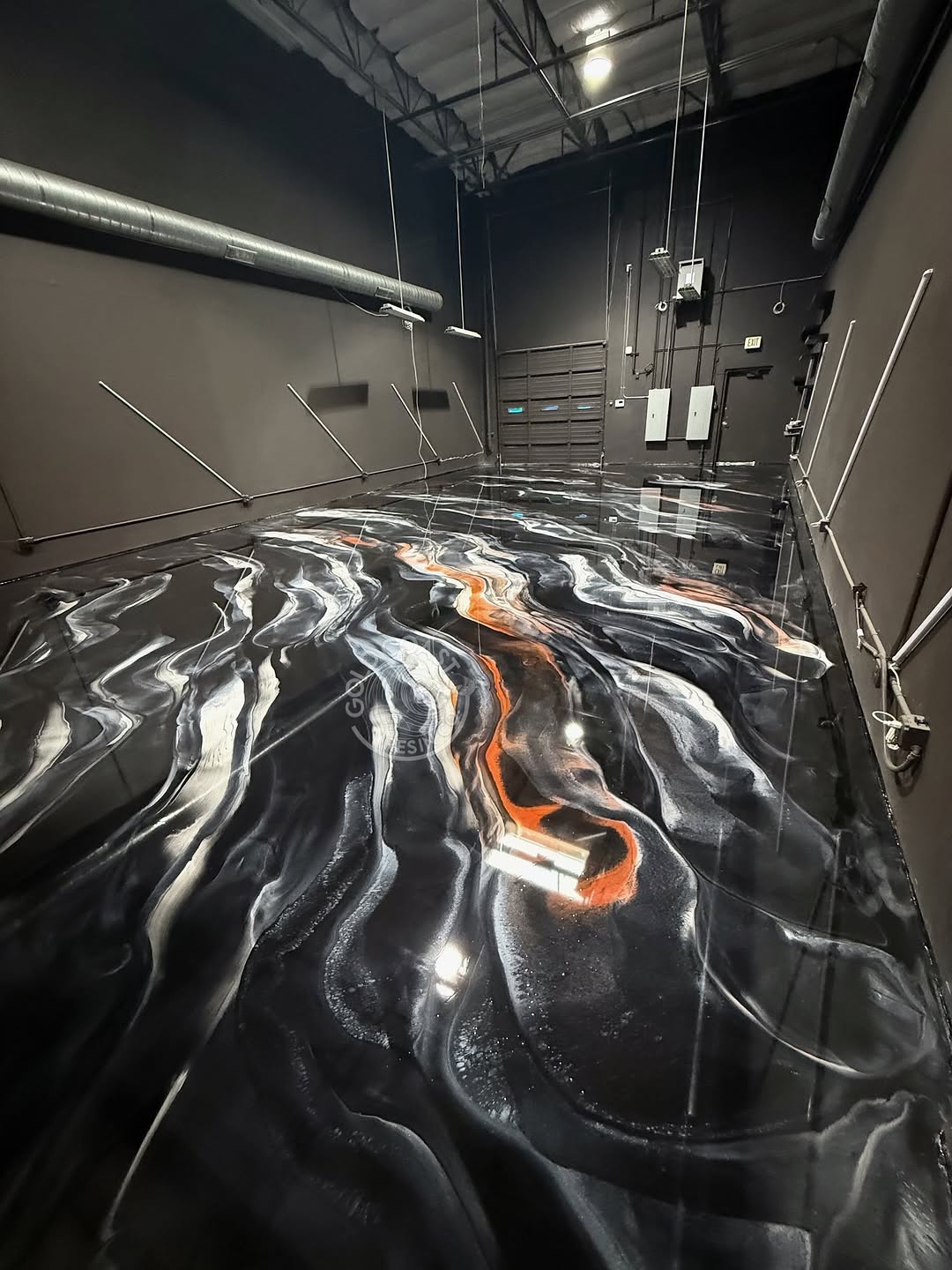
Color is the last decision. Working bays usually suit a solid gray or a dark flake that hides tire marks and dust between sweeps. A suite that doubles as a showroom or a front office can go further, with a black metallic veined in white and orange like the floor pictured at the top of this page, and the same prep and the same hard topcoat sit underneath either look.
Systems, film builds and topcoat options for shops and warehouses are laid out on our industrial coatings page.
What shop managers ask first
Will a coated floor take forklift traffic?
Yes, once it has fully cured. The lanes forklifts use get a thicker build and a hard topcoat, and the turning areas get extra attention because that is where wheels scrub. Johnny asks about your machines, their tires and how heavy they run loaded so the system matches the work.
Can you coat over oil-stained concrete?
After the oil is pulled out, yes. Stained areas are degreased and then ground until clean concrete shows through. A slab that keeps bleeding oil after grinding gets treated again before primer, because resin laid over oil lets go in patches sooner or later.
Do we have to shut the whole building down?
Usually not. Larger suites can be coated one bay or one section at a time while the rest keeps working, with the active area closed off and grinding dust held down by vacuums. The order of the bays and the dates each one returns come out of the site assessment.
Will the floor be slippery when it gets dusty?
A smooth gloss can be, which is why walkways and the door line get aggregate in the coat. Bays where carts and jacks roll most of the day can stay smoother for easy sweeping. Johnny marks out which areas get which texture before any coating goes down.
Can the striping go in at the same time?
It can, and it holds up better that way. Lines for aisles, bays, walkways and parking are laid out with you, painted into the system and sealed under the clear. Bring a sketch of the layout you want and it gets chalked onto the floor before coating.
How does summer heat change the schedule?
Heat speeds up the cure. In a metal building on a July afternoon the slab can run hotter than the air, which shortens the time there is to spread and level material. Johnny starts these jobs early in the morning and keeps product out of the sun until it goes down.
Get Johnny out to the bay
Tell us the square footage, what rolls across the floor and when the bay can sit empty. Johnny drives up from Hollister, walks the slab, tests it and puts prep and finish in writing as separate lines. There is no charge for the site assessment.
Finished floors are in the gallery. Prefer to write it down? Send Johnny the details and he will get back to you.