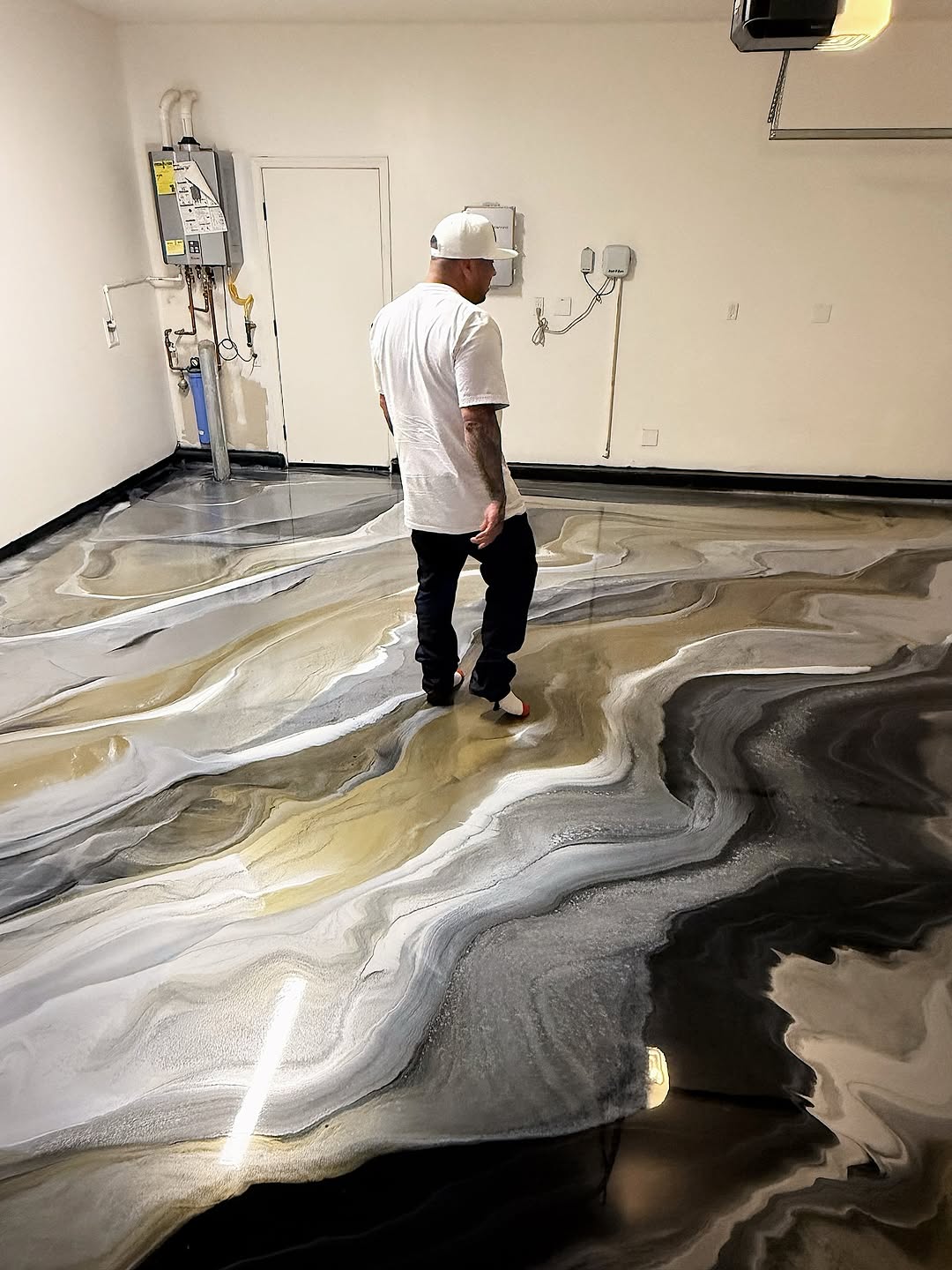
Garage Floor Coatings That Redefine the Space
A garage floor coating from Gold Coast Resin is not a weekend DIY project. It is a professionally engineered, multi-layer epoxy and polyaspartic system designed to turn your garage into a showroom-quality surface that handles tire traffic, chemical spills, and daily abuse without flinching.
JP Resin Certified·Don Resin Certified·160-Mile Radius
What Makes a Professional GARAGE COATING
The garage floor coatings you find at big-box stores and the systems Gold Coast Resin installs are fundamentally different products. Retail epoxy kits are thin, water-based formulations that sit on top of slab with minimal adhesion and begin peeling within months. Professional garage coatings are multi-layer systems that penetrate the slab substrate and build genuine thickness.
Gold Coast Resin’s garage coating system starts with aggressive diamond grinding that removes surface contaminants and opens the slab pore structure. A high-build primer coat penetrates deep into the prepared slab. The decorative layer follows, whether metallic swirl, broadcast flake, or solid color, each applied at professional thicknesses.
The difference between a professionally installed garage coating and a DIY kit is not subtle. It is the difference between a surface that looks incredible and performs flawlessly for a decade, and one that starts peeling before the first winter is over.
The Grind Is the Whole Job
If you remember one thing about garage coatings, make it this: the coating does not stick to your concrete because of chemistry. It sticks because of texture. Diamond grinding cuts a mechanical profile into the slab, and that profile is what a primer keys into. The industry measures it on a concrete surface profile scale, and for a thin polyaspartic system we open a floor to roughly CSP 2, while a heavier epoxy build wants CSP 3. Run your hand across a properly ground slab and it feels like fine grit sandpaper. That is the bond.
Acid etching, which is what most retail kits tell you to do, does not produce that profile. It cleans the surface and lightly opens it, and on a hard-troweled garage slab it barely does that much. It also leaves residue behind if it is not neutralized and rinsed perfectly, which almost never happens on a homeowner Saturday. That is the entire reason those kits peel in sheets a year later, usually starting right where the car tires sit.
Grinding also fixes problems you cannot see from standing height. It knocks down trowel ridges, levels the lip where a slab has heaved at a joint, and exposes cracks that were hiding under sealer. Those cracks get routed out with a crack chaser blade, filled with a rigid polyurea, and ground flush the same day. Control joints get honored or filled depending on how the slab has been behaving. By the time we prime, the floor is flat, clean, dry and open.
Moisture Testing, and Why We Insist On It
Concrete moves water. A slab poured without a vapor barrier, or over damp soil, or simply young enough that it has not finished curing, will push moisture vapor up through itself continuously. Put an impermeable coating over that and the vapor collects underneath until it has enough pressure to lift the coating off the concrete. It looks like blisters first, then like sheets peeling.
We test before we commit to a system. Calcium chloride kits measure how much vapor comes through a set area over a set time. A relative humidity probe set into a drilled hole reads what is happening inside the slab, which is the more reliable number. Either way we get an actual reading instead of a guess, and the reading tells us which primer to use. A slab that comes back high gets a moisture-mitigating epoxy primer before any decorative layer goes down. It adds a step and it is the difference between a coating that lasts fifteen years and one that fails in eighteen months.
Johnny works across a huge range of ground, from coastal slabs near Monterey Bay that never dry out to Central Valley slabs sitting in irrigated soil. The testing is the same everywhere. The answer it gives is different on almost every job.
Flake or Metallic, and What Each One Is Actually For
Most garage conversations come down to these two. A broadcast flake system is vinyl chips thrown into a wet base coat until the floor rejects any more, then scraped, vacuumed and locked under a clear. It gives you texture underfoot, real slip resistance when wet, and a surface that visually hides dust, tire marks and the occasional drip. Flake blends can be mixed to pick up the colors already in your house. For a working garage, a gym, or a family space that takes actual abuse, flake is usually the right call.
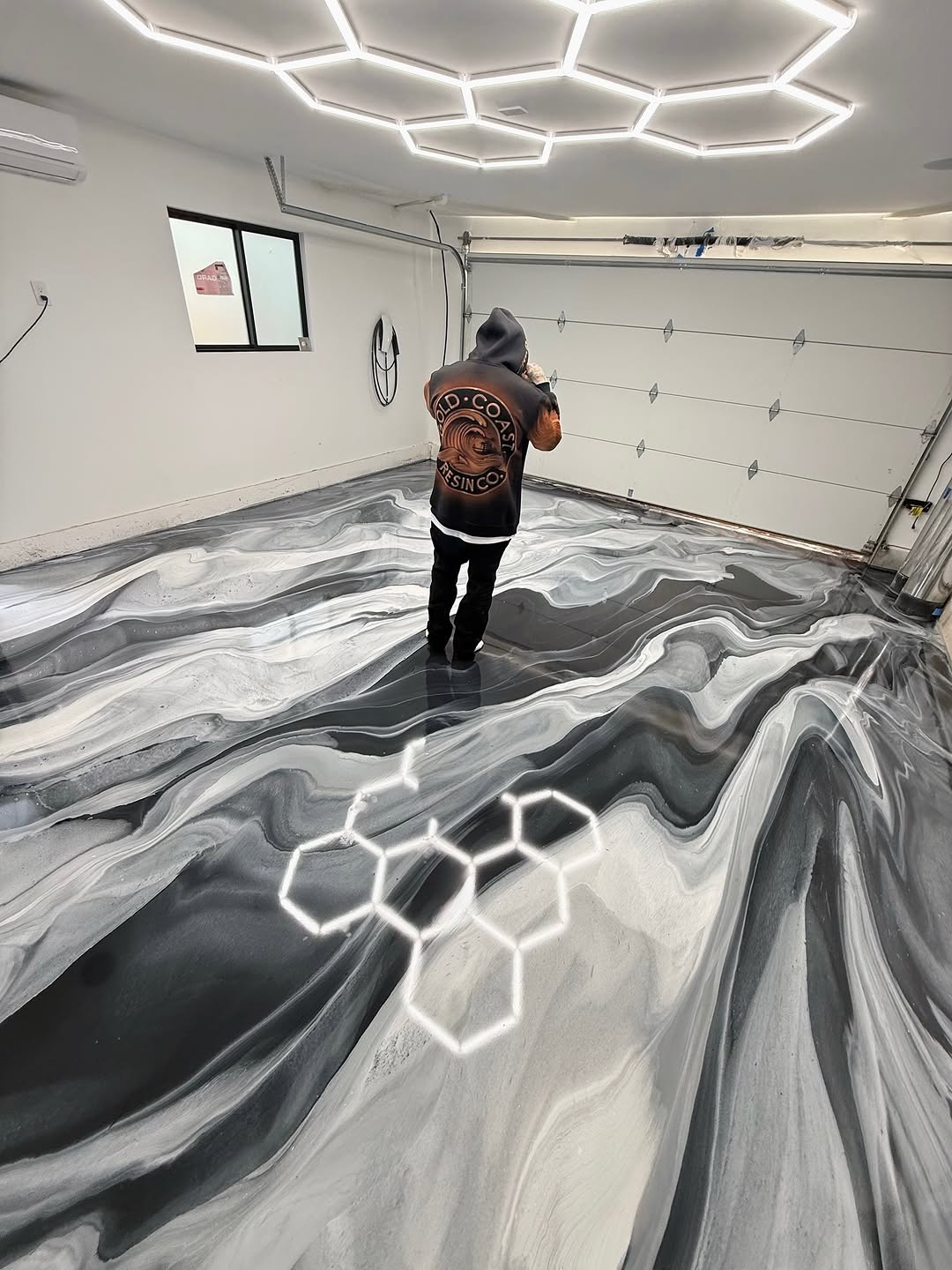
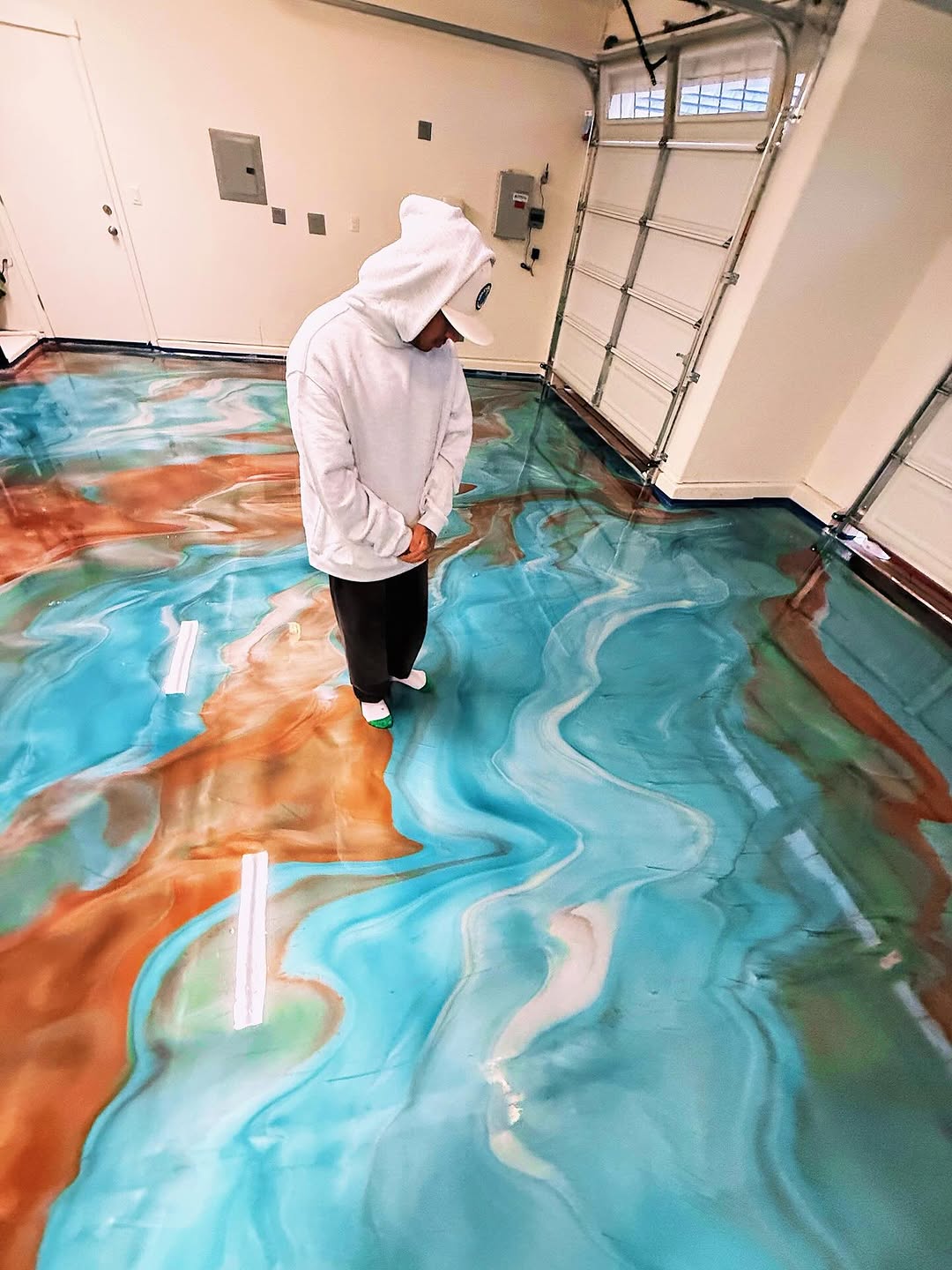
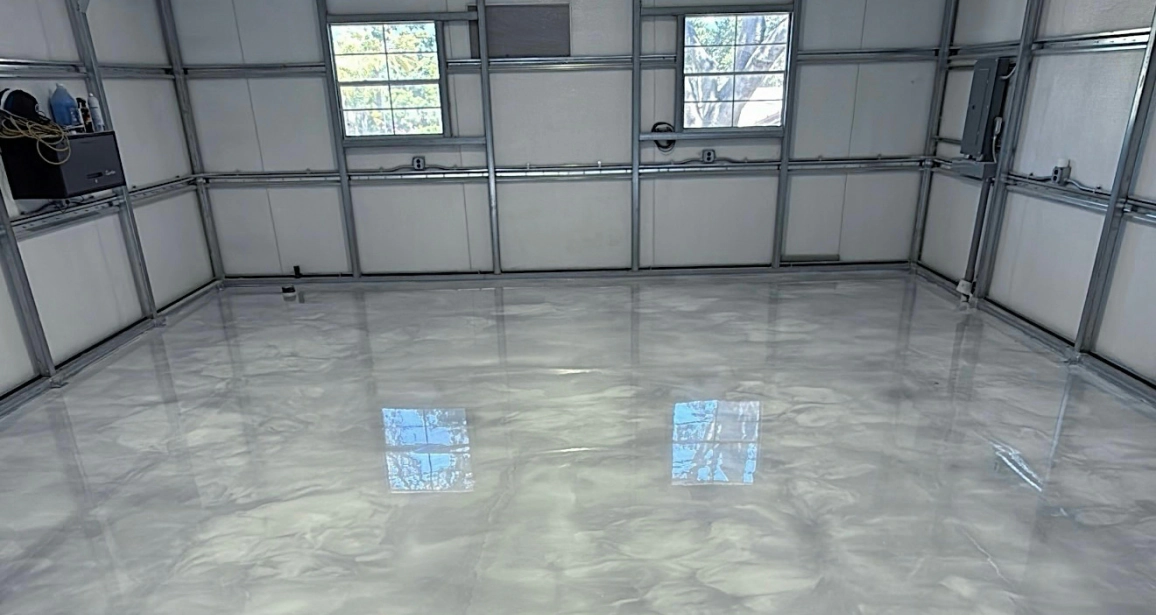
Metallic is the artistic system. Pearl and mica pigments are suspended in clear resin, poured, and then physically moved with rollers, blades and air until the pigment opens into cells and veins that read like poured stone. No two are the same, because the movement is done by hand and the material is a live thing while it works. Metallic wants a garage that gets shown off, a collector space, a shop that doubles as a hangout. It shows dust a little more readily than flake and it rewards you every time you open the door.
Both finish under a polyaspartic clear coat. That topcoat is UV stable, so a floor that catches direct sunlight through an open door will not amber the way older urethanes did. It resists hot tire pickup, which is the failure that ruins most amateur garage floors when a hot tire sits on a soft coating and pulls it up on the way out. It also cleans with a mop and a neutral cleaner, no waxing, no resealing on a schedule.
Living With the Floor Afterward
People ask what changes day to day. Sweeping gets easier, because there is nothing porous for grit to sit in. Oil drips wipe up instead of staining permanently. The garage gets noticeably brighter, since a coated floor reflects light instead of swallowing it, and most people end up putting a bulb or two less in the space than they expected to need.
Care is straightforward. Sweep or blow it out, mop with warm water and a pH-neutral cleaner when it needs it, and wipe up brake fluid or battery acid promptly since those are aggressive on any coating. Skip the harsh degreasers and do not park a floor jack on a bare metal wheel without a pad under it. That is genuinely the whole maintenance list.
Johnny handles every assessment himself. Call (650) 797-3040 for a free look at the slab and a firm price on the system your floor actually needs.
PROCESS
Every garage floor coating follows a precise four-stage process that prioritizes preparation, adhesion, and long-term performance.
Diamond Grinding
Industrial diamond grinders remove old paint, sealers, and contamination while creating a mechanical bond profile. We test for moisture, repair cracks, and fill joints for a flawless foundation.
Primer and Repair
A penetrating epoxy primer soaks into the prepared slab creating a deep chemical bond. Cracks, divots, and expansion joints are filled with flexible repair compounds.
Decorative Layer
Your chosen finish is applied at professional thickness. Flake systems get full broadcast, metallic coatings are hand-manipulated, solid colors are rolled in multiple passes for uniform coverage.
Topcoat and Cure
A high-performance polyaspartic topcoat provides UV resistance, chemical resistance, and abrasion resistance. Walkable within hours, ready for vehicles in two to three days.
GARAGE COATINGS
Garage floor coatings are one of the most common epoxy projects in California, which means there is no shortage of installers. The difference is in execution. Johnny Mendoza has coated garages ranging from single-car residential spaces to oversized four-car collectors’ garages.
What separates Gold Coast Resin starts with preparation that never cuts corners. Where many installers acid-etch and call it done, Johnny diamond grinds every floor. The materials are commercial-grade, not diluted retail formulations. And the installation timeline of two to three days reflects that proper coatings cannot be rushed.
Gold Coast Resin also understands that a garage coating is an investment. Johnny walks you through every finish option and helps you choose a system that matches both your aesthetic goals and how you actually use the space.
PROJECTS
Every garage transformation tells a story. Browse recent installations and visit our full project gallery for more.
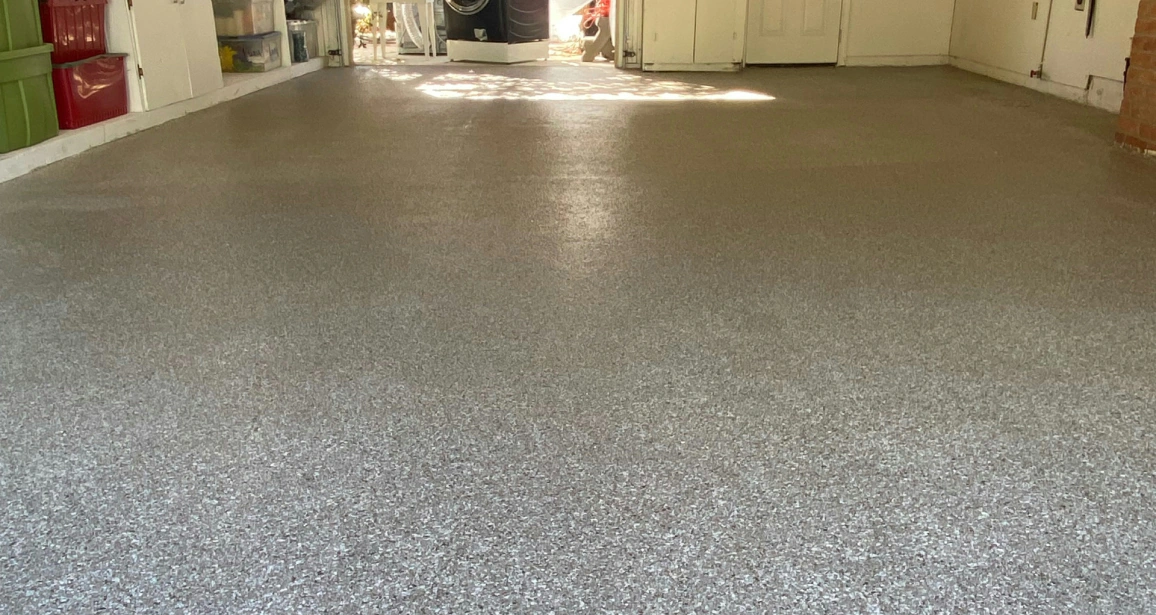
“Our garage went from an embarrassing oil-stained mess to the nicest room in the house. Johnny and his crew were professional, fast, and the flake floor they installed looks absolutely incredible. Friends keep asking who did the work.”Homeowner, Morgan Hill, CA
FAQ
FLOOR
Ready to turn your garage into the best-looking room in the house? Call Johnny for a free garage coating consultation and quote.