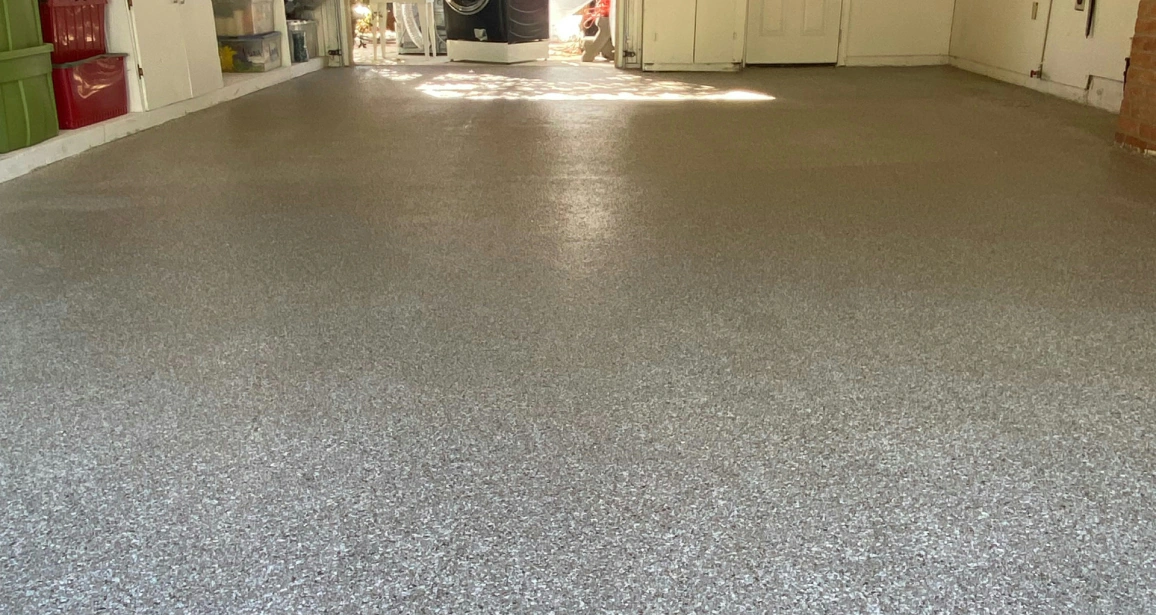
Ridgemark Flake Floors With Grip for Carts Rolling In Wet
Carts come home from the course with damp tires and park on the same patch of concrete every night. A full-broadcast flake floor gives that bay traction and swallows the marks, and Johnny Mendoza oversees every one from the first pass of the grinder to the final walkthrough.
JP Resin Certified · Don Resin Certified · Hollister Based
The trouble with a cart bay
A loaded golf cart is a lot of weight for a small patch of garage floor, and it turns in place every time it pulls in. Park one in the same spot for a few years and bare concrete keeps the record: darkened tire paths, a ring where water runs off the body, grime ground into the surface where the wheels stop.
Paint and thin roll-on kits tend to fail right there first. Warm tires can lift a weak film, and a wet tire turns a smooth glossy surface into something you would not want to cross in socks.
A flake system answers both problems with build and texture. The chips raise the floor well past what a roll-on coating can reach, and the sealed surface keeps a slight tooth that holds a shoe or a tire when the floor is damp. Scuffs that would stand out on a solid color get lost in the pattern.
That combination is why most Ridgemark owners with a cart end up here. The bay looks cleaner, it hoses off easily and nobody slides on it after a wet round.
A glossy smooth floor looks great right up until the first cart rolls in dripping. Texture is the part you will actually use every day.
Broadcasting chips until the floor refuses more
Every flake job starts with a diamond grind to open the slab and a HEPA vacuum to clear out the dust it leaves behind. After that the base coat goes down, and while it is still wet the chips get thrown by hand across the whole floor.
Full broadcast means we keep throwing until the base coat is buried and will not hold another chip. Stopping short saves material, but it leaves resin showing between flakes, which wears differently and looks patchy under a bay light. We do not stop short.
Refusal is an easy test to run. If the base coat can still grab a chip, the broadcast is not finished.
Coverage also reaches the places people forget. We carry the broadcast right into the corners and along the wall line, and where the garage has a step up into the house, that edge gets the same attention as the middle of the floor, since it is where feet land every single day.
Once the base has cured, the loose chips get swept up, and the surface is scraped with a blade to knock down edges standing proud. That scrape decides how the finished floor feels under a bare foot. Then comes the clear, and the clear decides how the floor cleans.
The clear we put over flake is usually polyaspartic. It holds up to sun coming through an open door and takes foot traffic the same day, which matters when the garage is also the way into the house. There is more on that topcoat on our Ridgemark polyaspartic page.
Picking a blend for foothill dust
We bring physical chip samples to the site assessment. These are the questions that actually narrow the choice.
Dust in a dry summer
Foothill dust settles on everything once the rain stops. Mid-tone grays and tans with some variation hide it between sweeps, while a very dark blend shows footprints by lunchtime.
How big the chips are
Larger chips read busier and hide more wear. Smaller chips give a calmer, tighter look and show a scuff a little sooner. Most cart bays land somewhere between the two.
The light in the bay
A floor near a bright open door looks different from one lit by a single ceiling fixture. We set samples where the cart actually parks and check them at the hour you use the space.
Matching the house
Some owners pick up the cabinet or trim color. Others want the floor to fade into the background. Both work, as long as you decide which before the sample board comes out.
How a flake floor wears with daily use
The chips carry most of the wear, so a flake floor keeps its look longer than a single-color coating does in a working bay. Tire scuffs and dropped-tool nicks mostly vanish into the pattern instead of standing out.
What changes first is the sheen of the clear in the lanes where tires turn. It shows up as a slightly duller path, and that is normal. Day-to-day care is a push broom and a damp mop with a mild cleaner. Harsh solvents and abrasive pads dull the clear faster than the carts ever will.
Carts deserve one more word. Johnny tells you when the floor is ready for one, and until then the cart stays out. Once it is back, avoid dragging it sideways to straighten it in the bay, and do not spin a locked wheel in place. Normal driving in and out is exactly what the floor is built for.
Storage along the walls makes no difference to how the floor ages, as long as heavy bins and shelving get lifted into position instead of scraped across the clear.
If a bay ever needs freshening up, the clear can usually be scuffed and recoated without disturbing the chips underneath, which is a much smaller job than starting over.
When a flake floor does fail early, the cause almost always traces back to prep or moisture rather than the chips. A troweled slab that was never ground, or a hillside garage with water pushing up from underneath, will lift any system at all. That is why Johnny grinds and tests before he ever talks color with you. If your garage does double duty as a gym or a shop, our Ridgemark garage coatings page walks through choosing a system by use.
Flake epoxy questions we hear around Ridgemark
Will a flake floor be slippery when a cart comes in wet?
Less so than a smooth coating. The scraped chips leave a slight tooth under the clear, and aggregate can be added to the topcoat in parking lanes for extra grip. We talk through how much texture you actually want, because more grip also means a little more effort with the mop.
When can I park my golf cart on the new floor?
You can walk on a polyaspartic clear that evening. On a standard garage in decent shape, most carts and cars go back in the next day. A damp slab or a cold week can push that out, and Johnny confirms the timing on installation day.
Does flake really hide tire marks and scuffs?
That is one of its biggest strengths. A multicolor chip pattern breaks up tire tracks, dropped-tool nicks and everyday grime that a solid color puts on display. A deep gouge will still catch the eye under direct light, but in a working bay most of the daily wear simply stops registering.
Which blend handles foothill dust best?
Mid-tone blends mixing light and dark chips tend to hide dust best between cleanings. Very dark blends and very light ones both show it quickly. If you want to match cabinets or trim, keep a sample of that color handy, and we will lay chip samples right on your floor to compare.
Is full broadcast worth it over a partial broadcast?
For a cart bay or a busy garage, we think so. Partial broadcast leaves resin exposed between chips, which wears differently and gives uneven texture. Full broadcast buries the base coat completely, so the floor feels the same from wall to wall and hides considerably more of the wear it collects.
Is the work covered by a warranty?
Yes. Every Ridgemark flake floor comes with a workmanship warranty, and Johnny oversees the job from the first consultation through the final walkthrough. Ask about the terms at the site assessment and he will go over what the warranty covers in writing, well before you commit to a start date.
See chip samples on your own slab
A free site assessment settles most of the decisions in one visit. Johnny looks over the concrete, sets blend samples down right where the cart parks so you judge them in your own light, and puts the price in writing before anything goes on the calendar.
Browse finished flake floors in the gallery, or tell Johnny about your bay and he will be in touch.