Restaurant Flooring, Beautiful, Safe, Kitchen-Tough
Restaurant flooring from Gold Coast Resin solves the impossible design problem: your kitchen floor needs to survive thermal shock and grease while your dining room needs to look stunning. Our resinous systems deliver both, with slip-resistant back-of-house surfaces and polished front-of-house finishes.
JP Resin Certified·Don Resin Certified·160-Mile Radius
The Restaurant Flooring CHALLENGE
Every restaurant is actually two completely different environments. Your commercial kitchen is a war zone of thermal shock, grease, acidic food spills, heavy equipment, and aggressive cleaning chemicals. Behind the pass, your floor takes abuse that would make an industrial warehouse look gentle.
Your dining room tells a different story. Guests see your floor before they see your menu. A beautiful, polished floor communicates quality and attention to detail. But the dining room still needs to handle chair dragging, dropped plates, wine spills, and daily mopping without scratching or dulling.
Gold Coast Resin installs restaurant flooring that addresses both environments. Urethane cement and heavy-duty epoxy protect your kitchen. Decorative metallic, flake, and polished epoxy give your dining room visual impact. The transition between the two is smooth and continuous.
Why Kitchens Get Urethane Cement
Straight epoxy is a good product in the wrong place when it goes into a commercial kitchen. The reason is thermal shock. When a dishwasher dumps water near boiling onto a slab that is sitting at room temperature, the coating expands and the concrete underneath does not, and that mismatch works at the bond every single service. Do it twice a day for two years and a rigid epoxy starts to crack and release, usually right in front of the dish pit where you least want a repair.
Urethane cement is built for that. It is a cementitious urethane system with a coefficient of thermal expansion close to concrete’s own, which means the floor and the coating move together instead of fighting. It also shrugs off the things that eat epoxy in a kitchen: lactic acid from dairy, citric acid from produce prep, animal fats, and the aggressive alkaline cleaners used at close. We install it thicker than a decorative system, typically as a slurry with an aggregate broadcast for grip, and we detail it up the wall as an integral cove base so there is no seam at the floor-to-wall joint for grease and organic material to pack into.
Drains get the same attention. We build slope where slope has been lost, terminate the coating into the drain body properly, and make sure water leaves the floor instead of standing in a low spot behind the line. A kitchen floor that drains is a kitchen floor that stays clean.
Slip Resistance Is a Staffing Issue
Grease plus water plus a cook moving fast is how people get hurt, and it is also how insurance claims start. The traction on a resin floor comes from the aggregate we broadcast into the topcoat, and the size of that aggregate is a real decision rather than a default. Too little and the floor is slick the moment anything spills. Too much and your staff cannot push a mop across it, which means it does not get cleaned properly, which is worse.
We set the texture by zone. The line and the dish area get the most aggressive profile because that is where the water and grease live. Prep and walk-in approaches get a moderate texture. The pass and service corridors get enough grip to be safe in clogs without turning into sandpaper. Johnny will walk the space with you and mark those zones before anything is mixed, because the person who works the line every night knows where the floor gets dangerous better than any spec sheet does.
The Dining Room Is a Different Conversation
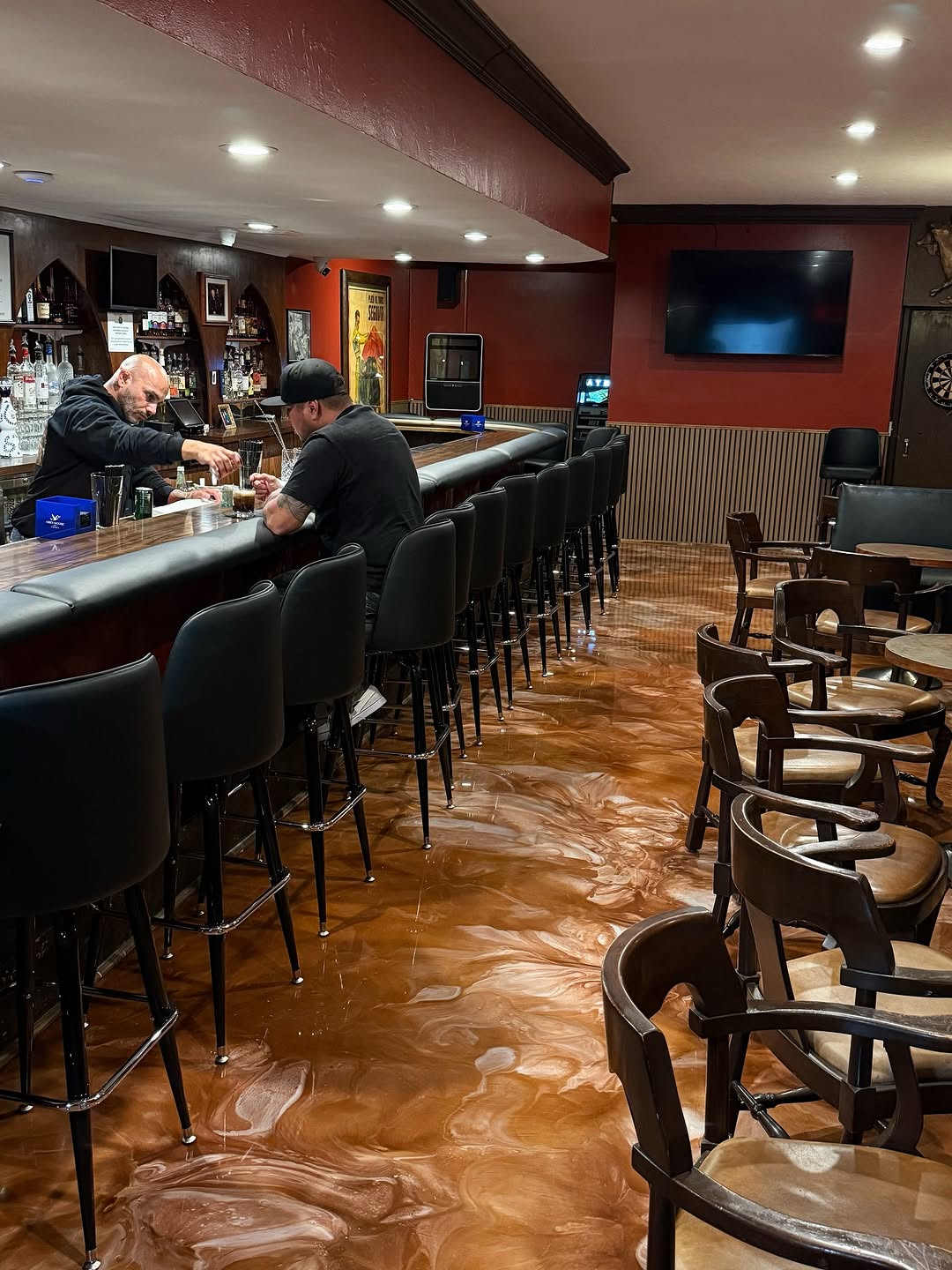
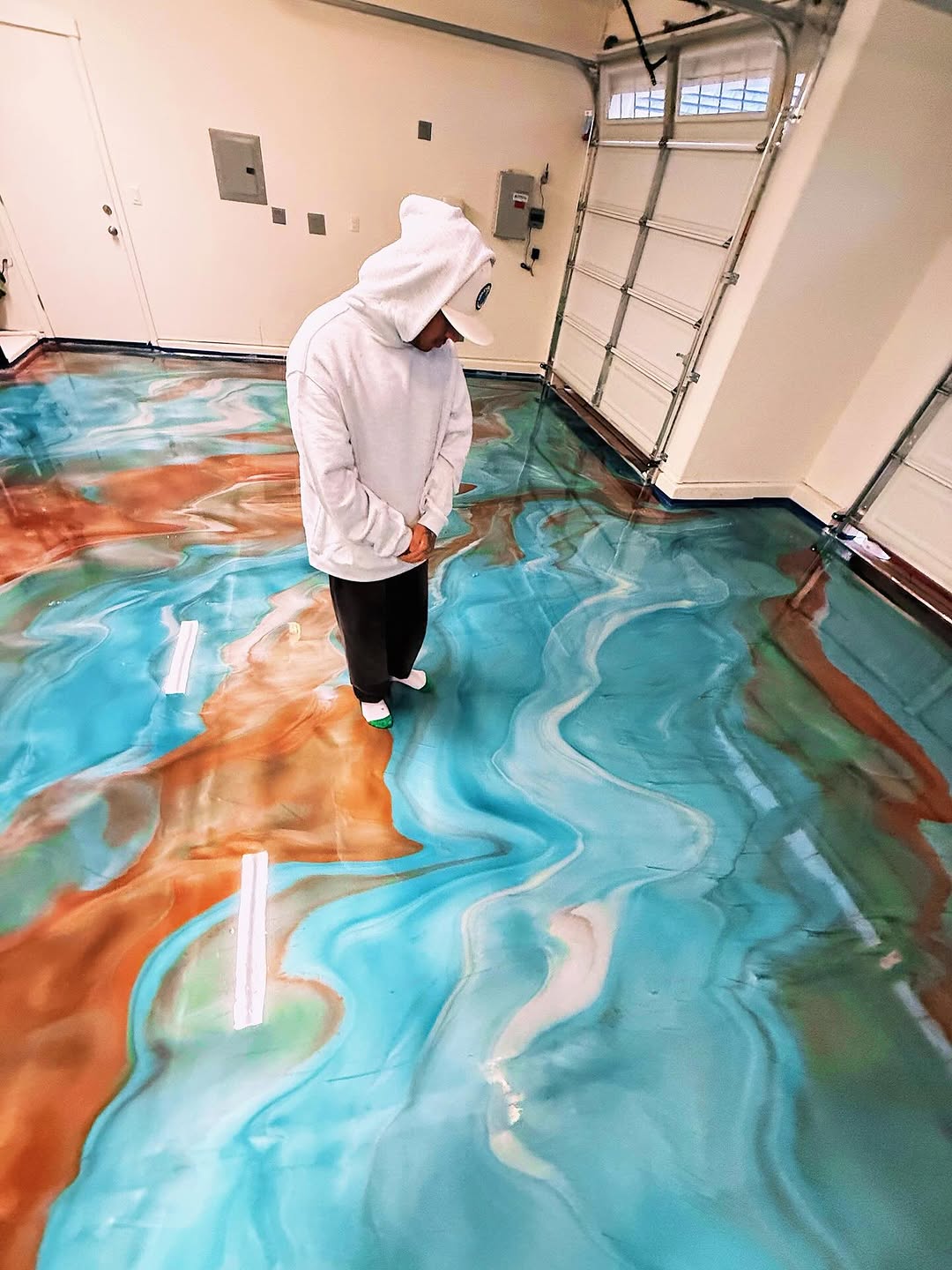
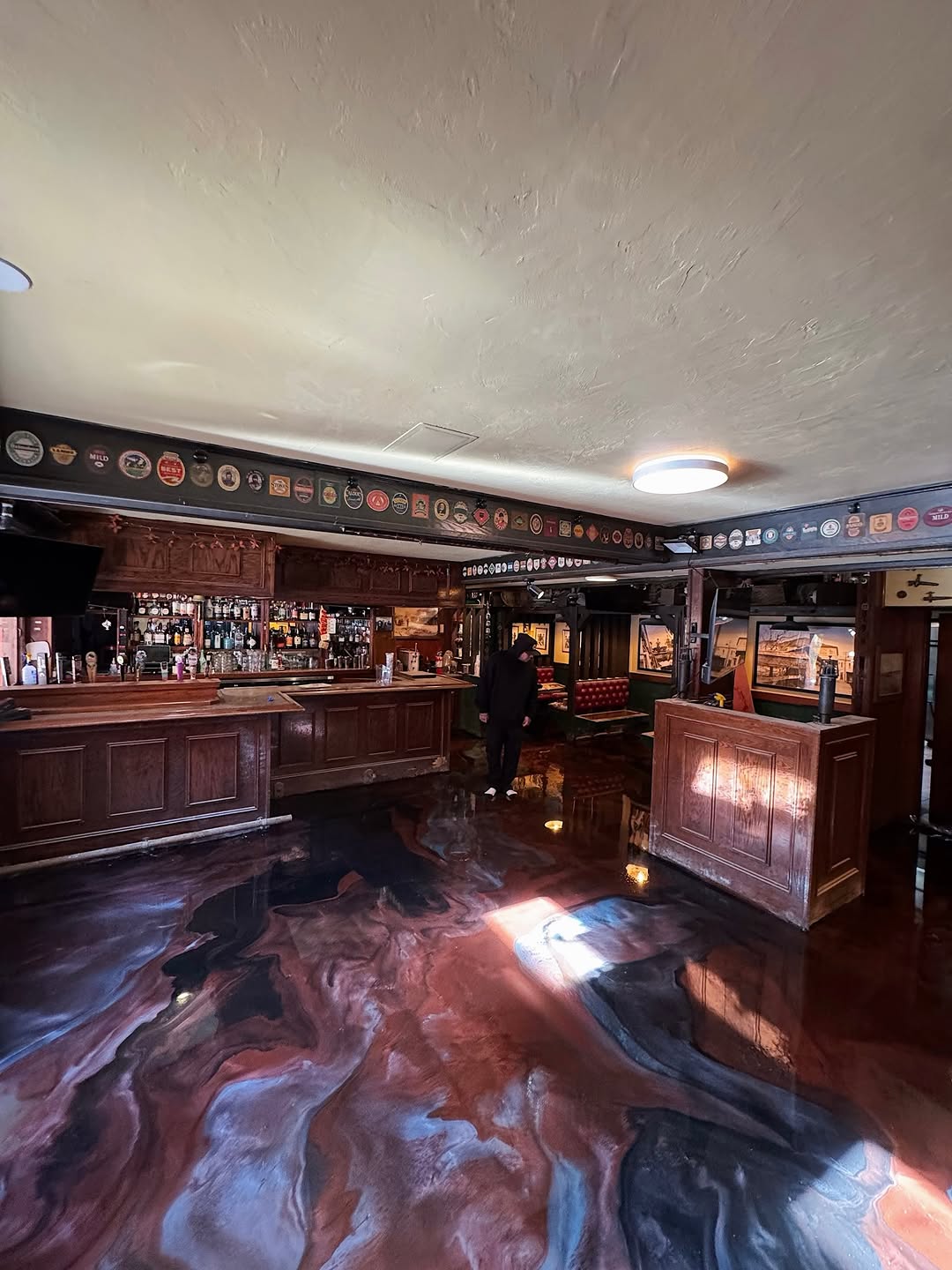
Out front the priorities flip. Now the floor is part of the room, and guests read it before they read the menu. Metallic epoxy is the most requested system for this, because the pigment movement produces depth that looks like stone or water rather than like a painted surface. Every one is unique, since the pattern comes from Johnny working the material by hand while it is still open. Polished concrete is the other direction, quieter, architectural, and a good fit for rooms where the walls and the food are doing the talking.
Both get a clear coat chosen for the traffic. In a dining room the concern is chair drag, dropped plates, wine and coffee, and the daily mop. A polyaspartic clear handles the abrasion and the staining, holds color under whatever light you have hitting it, and cleans without waxing or resealing. Where the dining room meets the kitchen we carry the coating through the doorway so there is no threshold strip trapping debris and no lip for a server carrying a tray to catch a toe on.
Getting It Done Without Closing for a Week
The question every operator asks first is how long they are dark. The honest answer depends on square footage and slab condition, but the schedule is almost always built around your closure, not ours. Kitchens are commonly done in a Sunday-to-Wednesday window or over consecutive overnight shifts, phased so half the line stays usable when the layout allows it.
Prep is the same discipline as any of our work, adjusted for food service. Existing tile, quarry tile and thinset come out. The slab gets diamond ground or shot blasted to a CSP 3 or heavier profile depending on the system going down, because urethane cement needs a deeper bite than a decorative floor does. Grease that has soaked into the concrete gets degreased and ground past, and we check the dust color coming off the machine to confirm we are into clean material. We run moisture testing before priming, since a slab that has been under tile for twenty years has been trapping water the whole time.
Health inspections, cure times, and the reopen date all get discussed before we start, not discovered along the way. Call Johnny at (650) 797-3040 and he will come take a free look at the slab, walk both sides of the house with you, and put a firm price on paper.

PROCESS
Every restaurant floor follows a four-phase installation process designed for food safety compliance and minimal business disruption.
Restaurant Assessment
Johnny evaluates kitchen layout, cooking equipment positions, drain locations, walk-in cooler transitions, dining room traffic, and aesthetic goals. Zone-specific coating systems are specified.
Surface Preparation
Industrial diamond grinding removes existing flooring and grease contamination. Thorough degreasing in kitchen areas ensures bonding. All cracks, joints, and damage repaired.
Zone-Specific Application
Kitchen receives urethane cement or heavy-duty epoxy with aggressive slip-resistant texture. Dining areas receive decorative systems matched to your brand. Seamless transitions between zones.
Inspection and Compliance
Slip resistance testing, health code compliance verification, and complete documentation. Fast-cure systems get your restaurant open as quickly as possible.
GOLD COAST RESIN
Restaurant flooring failures cost more than just the floor. A slip-and-fall means workers comp claims. A failed health inspection means lost revenue. A cracked dining room floor tells guests that details do not matter here.
Our systems provide slip-resistant finishes tested to OSHA and ADA standards. Thermal shock protection handling freezer transitions to boiling water. Aesthetic front-of-house options in metallic, flake, and polished finishes. Health code compliance with smooth, non-porous surfaces and integral cove base.
Johnny has installed floors in restaurants running sixteen hours a day. His certifications mean your restaurant floor is built to last through years of the most demanding conditions food service can produce.
PROJECTS
From fine dining to fast casual. See more in our full project gallery.
“Our kitchen floor survived the busiest season we have ever had without a single issue. The dining room looks incredible, guests comment on it constantly, and our health inspections have been perfect since Johnny installed the system. Worth every penny.”Restaurant Owner, California
FAQ
INVESTMENT
Call Johnny for a free restaurant assessment. Slip-resistant kitchen floors and stunning dining room finishes for California restaurants, cafes, and food service facilities.