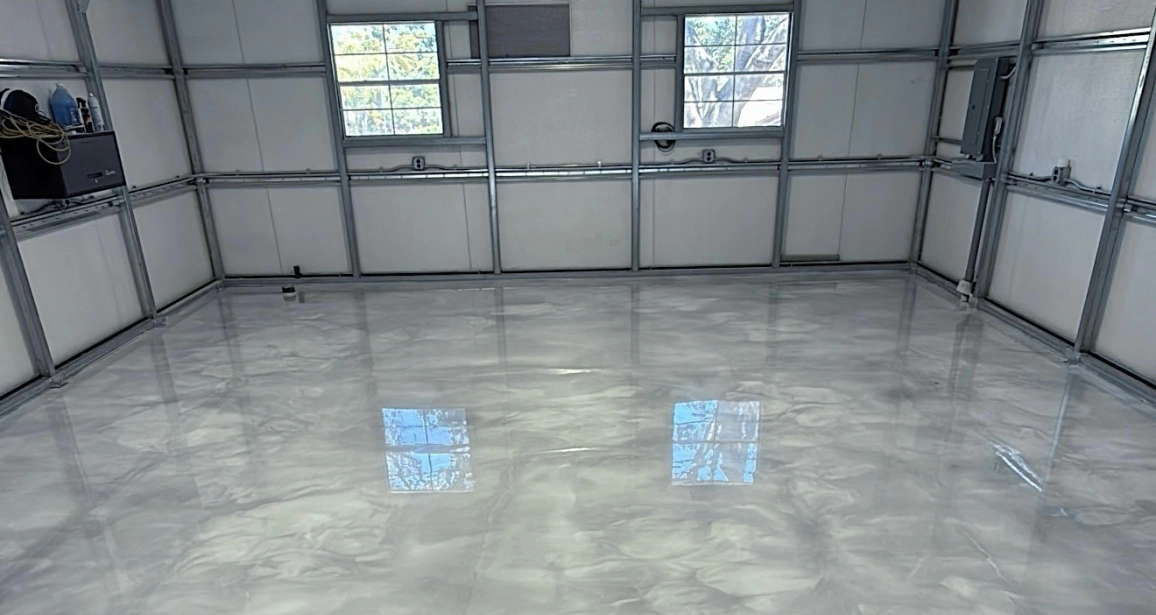
Modesto Commercial Floors Spec’d for the Work That Happens On Them
Stanislaus County commercial floors are not office floors. A lot of them handle produce, dairy, processing runoff or equipment traffic, and each of those wants a different chemistry. Johnny asks what happens on the floor before he quotes it.
JP Resin Certified · Don Resin Certified · Serving Modesto
SECTORS
Modesto commercial work splits into genuinely different rooms. We treat each as its own spec rather than running one package across the county.
Ag processing and packing
Packing houses, cold rooms and processing floors that see produce acids, constant washdown and thermal cycling. Urethane cement rather than standard epoxy in the wet zones, because organic acids eat epoxy over time.
Food and beverage
Kitchens, breweries and bottling rooms. Coved base so there is no square corner for water to sit in, seamless surface with no grout, and a slip rating that works with product on the floor.
Retail along McHenry
Storefronts and showrooms where the floor is part of the impression. Installed overnight so the doors open on time, and durable enough for daily foot traffic and tracked-in valley dust.
Shops and light industrial
Equipment bays, fabrication space and warehousing. Thickness and joint treatment matter more than appearance, and the joints are where these floors actually fail.
Why ag country needs different chemistry
The thing that makes Stanislaus County commercial work distinctive is what ends up on the floor. Produce acids, dairy, sugars from fruit processing and the cleaning chemistry used to wash all of it off are considerably harder on a coating than foot traffic ever is. A standard epoxy rated for a warehouse will soften and break down in a packing house within a couple of seasons.
That is why we ask what runs through the room before quoting rather than after. A floor rated for the wrong chemistry fails quietly: it does not peel dramatically, it just goes soft and starts holding stains, and by the time anyone notices the surface is gone.
In genuinely wet processing zones the answer is usually urethane cement rather than epoxy. It handles thermal shock from hot washdown, tolerates organic acids, and can be laid thick enough to take the equipment traffic those rooms see. It costs more per square foot and it lasts in conditions that destroy the cheaper option.
Tell us what gets spilled and what it gets cleaned with. Those two answers decide the system more than square footage does.
Scheduling is the other half. A packing house cannot close during harvest and a restaurant cannot close on a Friday, so most of this work happens overnight or across a weekend with fast-cure systems that take foot traffic in hours rather than days. Larger floors get phased so part of the space stays usable, with break lines planned to land under a wall or a fixture rather than across open floor.
Joints get treated as joints. A large slab expands and contracts, and coating straight over a control joint means a crack telegraphs through within a season. They get filled flexible and honored in the surface rather than buried, which is the difference between a floor that ages well and one that looks cracked in year two.
Every job is walked first and quoted as a firm number, with any slab repair itemized separately so you can see what is prep and what is finish.
Harvest timing shapes the calendar here more than anything else. Packing and processing floors cannot be touched during a run, so the work window is the gap between seasons and it is short. Booking early matters in this county in a way it does not elsewhere, and we would rather tell you in February that your only realistic window is March than discover it together in September.
Back-of-house rooms usually take a flake system, and where a fast turnaround matters polyaspartic is worth understanding. Full detail on the main industrial coatings page. We serve Modesto and Stanislaus County.
Modesto Commercial Coatings FAQ
We run a packing house. Will a standard epoxy hold up?
Usually not in the wet zones. Produce acids and dairy break epoxy down over time, and hot washdown adds thermal shock on top. Those rooms want urethane cement, which costs more per square foot and survives conditions that destroy a standard system. Dry storage and corridors alongside them can often take a normal epoxy, so the building frequently needs more than one spec.
How long do we have to close?
Usually not at all. Most commercial work here happens overnight or across a weekend using fast-cure systems that take foot traffic in hours. A single room is often one night. Larger floors get phased so part of the space stays open. Tell us your season and your hours first, particularly around harvest.
Will it pass a health inspection?
A properly specified food-handling floor will: coved base so there is no square corner for water and product to collect, seamless with no grout line, and a slip rating appropriate to a wet floor. Those are the parts a cheap quote leaves out. If an inspector has given you a specific comment, tell us what it said and we spec against it directly.
Our floor is cracked and patched. Is coating it worthwhile?
Depends what the cracks are doing. Static cracks get filled rigid and disappear under the coating. Cracks still moving, or areas patched repeatedly, mean the slab is shifting and no coating fixes that. We will tell you which you have rather than filling everything and letting it reappear.
Can you add line marking?
Yes, and we inlay it into the floor rather than painting it on afterward. Inlaid walkway lines, bay divisions and safety markings outlast painted ones by years, which matters anywhere forklifts or pallet jacks cross them daily.
Do you carry certifications?
JP Resin and Don Resin certified, and we can produce insurance documentation for a landlord or a compliance file. If you need paperwork for a board or an auditor, ask and it comes with the quote rather than being chased afterward.
Get your Modesto commercial floor quoted
Tell us the square footage, what runs across the floor, and what it gets cleaned with. Johnny walks it before anything is priced.
Finished floors are in the gallery, or send Johnny the details.