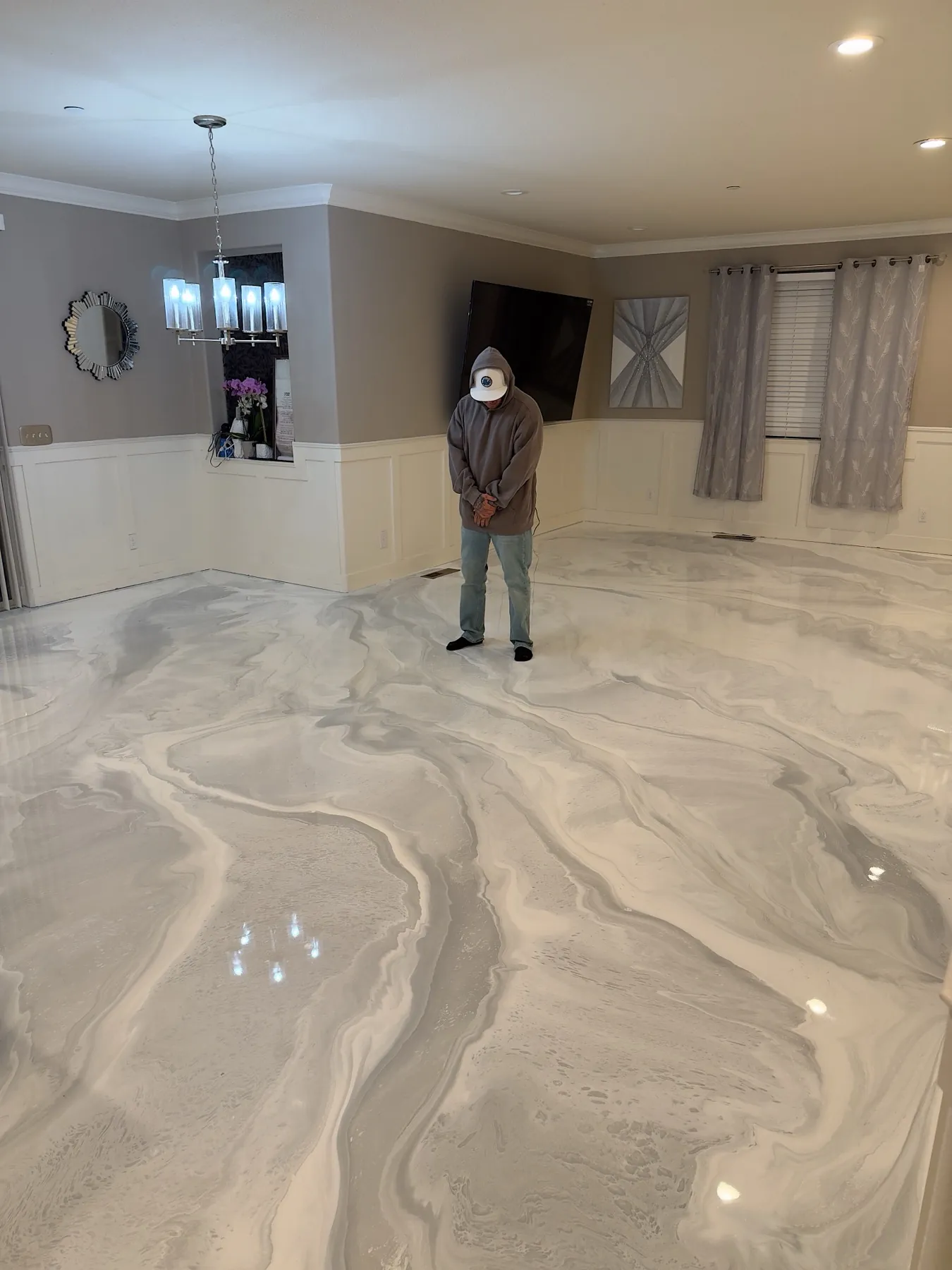
Turlock Living Room Floors Poured in Metallic Resin
When the carpet comes up in a slab-on-grade house, the concrete underneath can become the finished floor. A metallic coating is poured over it and worked by hand, so the pigment settles into swirls and veins that read like polished stone. Johnny Mendoza plans the color, the timing and the furniture with you before anything gets mixed.
JP Resin Certified · Don Resin Certified · Working Out of Hollister
What comes off the slab before any color goes down
Most houses that end up with a metallic floor had something else covering the concrete for years, and each old material leaves its own kind of mess behind.
Carpet and tack strip
Carpet and pad pull up fast. The tack strip nailed around the room is another matter, leaving rows of small holes and splinters along every wall. Those get pulled, filled and ground smooth, or they print through the metallic as a line of dimples at the baseboards.
Tile and thinset
Ceramic tile breaks loose with some effort, but the thinset under it stays stuck in hard ridges. That layer is ground off completely. Metallic resin goes on thin and levels itself, so any ridge left behind turns up later as a bump in the reflection.
Vinyl and adhesive
Sheet vinyl and glued plank floors leave adhesive behind, sometimes in thick trowel lines. Old glue softens with warmth and fights a new coating for its grip, so it all comes off down to clean, open concrete before the first coat is mixed.
Cracks the carpet hid
Once the covering is gone, hairline cracks and the odd settlement crack show up across the room. Johnny maps them, fills the stable ones and tells you plainly if one is still moving, because a crack that moves will show through any floor eventually.
Choosing a color by daylight and again under the can lights
A metallic floor is mostly reflection. The pigment catches whatever light is in the room and throws it back, so one blend can look like two different floors at nine in the morning and nine at night.
Daylight through a big front window is cool and even, and it brings out the gray and blue notes in a silver. Warm recessed lights in the evening push that same silver toward champagne, and every can shows up in the gloss as a soft pool of light. Copper and bronze blends shift the other way, turning deeper and redder after dark.
So Johnny sets sample boards down in the actual room and leaves them there. Look at them with the blinds open, again once the lamps come on, and one more time with the TV going. The color you still like at the end of the day is usually the right one.
Judge a metallic sample in the room it is going into, at the hour you spend the most time there.
Walls and trim matter as well. White wainscoting and gray walls, like the room in the photo, make a silver and white floor read bright and clean. Wood trim and warm paint usually sit better with copper, bronze or a deep charcoal.
Gloss is a separate decision. A high gloss shows the most depth and the most reflection of the light fixtures. A satin clear softens both, and some owners prefer it in a room with a lot of windows.
A light silver floor shows more than a dark one
Light silver and white floors are bright, and they make a room feel bigger. They also show the darker things that land on them: grit carried in from the yard, a scuff from a shoe sole, a gray smear where a chair leg dragged across.
Socks tell the truth on any smooth floor. Walk a light one for a day and the soles turn gray from fine dust you never noticed. A dark floor hides scuffs better but shows pale dust and pet hair whenever low sun rakes across it. Mid-tone blends with plenty of movement hide the most.
Upkeep is simple either way. A dry dust mop most days, a damp mop with a neutral cleaner each week, felt pads under every chair and table leg. Skip harsh degreasers and anything that leaves a film behind.
Dust off the surrounding farm ground finds its way through every door in Turlock, especially once harvest gets going. A good mat inside each entry catches most of it before it reaches the floor.
Felt pads under every leg do more for a metallic floor than any cleaner on the shelf.
Valley summers, early pours and moving back in
Resin cures faster as it warms, and Turlock summers run past a hundred degrees for long stretches. An air-conditioned room helps, but a hot afternoon still steals the time the material needs on the floor to be worked. Johnny starts these pours early in the morning, keeps the material out of the sun until it goes down and adjusts the mix for the temperature he finds.
Plan the order of the house before a date is set. Furniture comes out of every room being coated, along with the baseboards if you want the floor to run clean to the wall. Doorways into rooms that are not part of the job get sealed off so dust stays out of the wet coat.
Hallways and adjoining rooms can go down in the same pour, so the floor runs from one space to the next without a transition strip at each doorway. That continuous run is a large part of why people choose metallic for the inside of a house.
After the clear coat, the room goes back together in stages. Socks only at first, then light furniture on felt pads, then heavy pieces and rugs last. A rug laid down too soon can mark the finish, so it waits longest. Johnny writes the timing down for your floor so nobody in the house has to guess.
Pets need a plan of their own. Dogs and cats stay out of the coated rooms until the clear coat has hardened enough to shrug off claws, and a baby gate across the doorway is often all it takes. Paw prints in a wet metallic are hard to miss and impossible to brush out, so the gate stays up until Johnny says it can come down.
Color blends, finishes and more finished rooms are on our metallic floors page.
Before the carpet comes up
Can a metallic floor go over the tile I already have?
Johnny would rather take it up. Grout lines and loose tiles telegraph through a thin metallic layer, and one hollow tile can crack the floor poured over it. Removing the tile and thinset and grinding the slab gives the resin clean, sound concrete to bond to, which is where it holds best.
Is a light silver floor hard to keep clean?
It shows dark grit and scuffs sooner than a mid-tone floor, so it rewards a quick pass with a dust mop most days. A damp mop with a neutral cleaner handles the rest. Felt pads under the furniture and a mat at each door keep most marks from ever reaching it.
Will it be slippery in socks?
A glossy floor is smoother than carpet, and socks on any smooth floor slide more than bare feet do. A satin clear, a fine grit in the topcoat or a runner in the busiest walkway all help. Johnny brings textured samples so you can feel the difference before choosing one.
Does the floor feel cold underfoot?
It feels about like the concrete it sits on, which is welcome in a Turlock July. On winter mornings it runs cooler than carpet did. Area rugs in the seating areas take care of that once the floor has fully cured, and they come in handy for sound as well.
Can you pour in the middle of summer?
Yes, with an early start. Heat shortens the time the pigment can be moved, so Johnny begins in the cool of the morning, keeps the material out of the sun and adjusts the mix for the temperature in the room. Keeping the house cool that day helps as well.
When can furniture go back in?
In stages. Socks first, then light pieces on felt pads, then heavy furniture and rugs last. The exact timing depends on the products used and the temperature during the job, so Johnny writes it out for your room before the work is booked, and you can plan the move around it.
Let Johnny see the room before you pick a color
Send a few photos of the room, what covers the floor now and roughly when you would like the work done. Johnny comes over from Hollister, looks at whatever concrete he can see, and brings metallic samples to lay down in your own light. There is no charge for the site assessment.
More finished interiors are in the gallery. Rather send a message? Write to Johnny through the contact page.