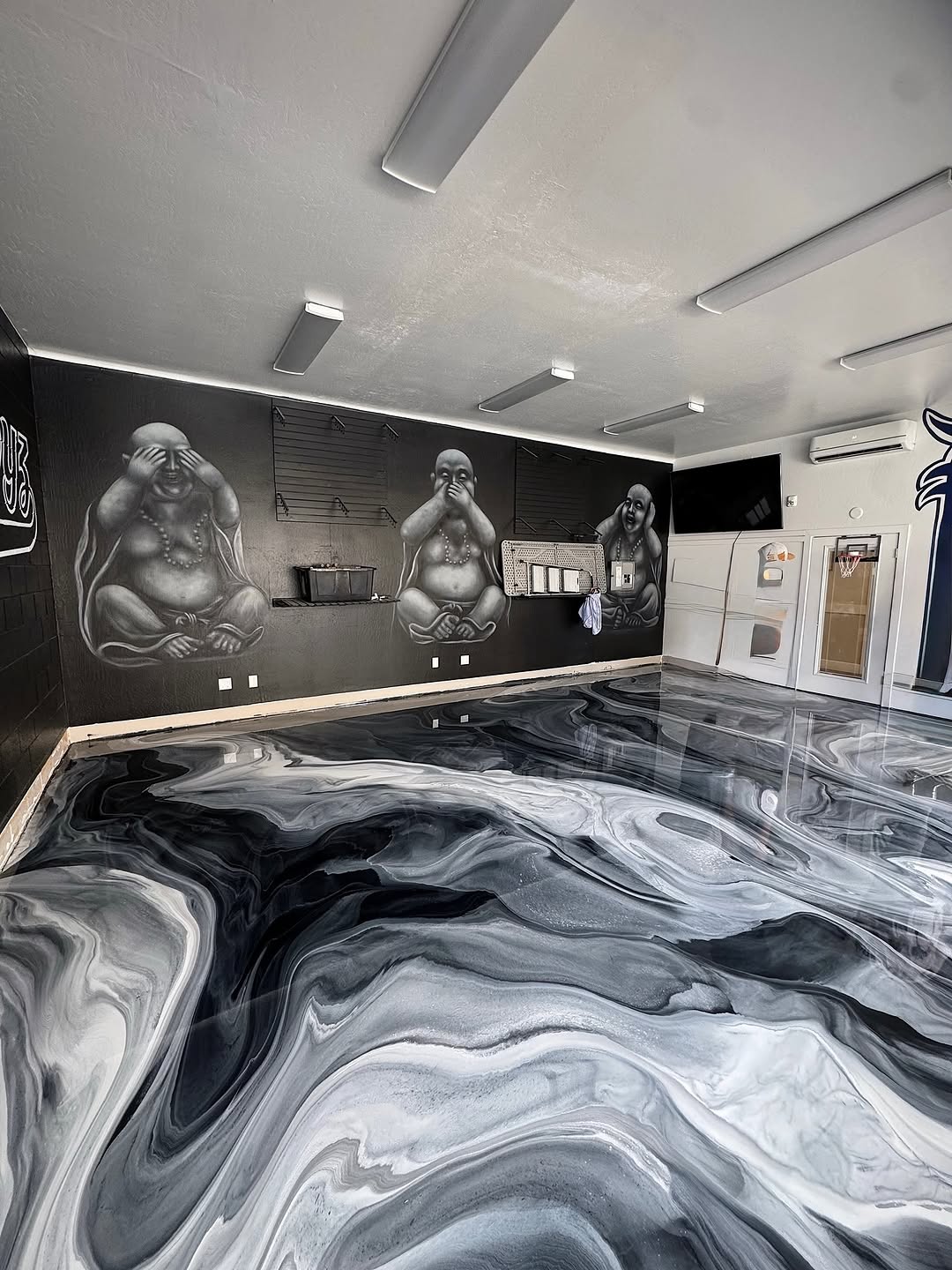
San Juan Bautista Shop Floors Laid Around Your Stock
Shops and galleries on the historic Third Street strip see their heaviest foot traffic on weekends, when visitors come through town. The floor has to handle that, look right inside an old building and go down without the store emptying its shelves. Johnny Mendoza plans retail work in sections, and it starts with a hard look at the slab.
JP Resin Certified · Don Resin Certified · Hollister, Down Highway 156
Wet shoes at the door and grip where it counts
The first few steps inside a shop door take the hardest wear in the room. Rain and morning dew come in on shoes, and during harvest a fine layer of field dust rides in with them. A smooth gloss can look wonderful in the middle of the floor and turn slick exactly where people step in from outside.
So texture goes in by zone. Fine aggregate is broadcast into the final coat at the entry and along the main walkway, and the rest of the floor stays smoother so it reads clean and sweeps easily. Customers will never see where one zone ends. They will feel it on a wet afternoon.
Register counters get similar thought. Staff stand and pivot in one spot for hours, so that patch gets a touch more grit and a full-thickness topcoat to take the twisting.
Weekend visitors tend to follow one path: in the door, a loop past the front displays, then over to the register. That loop is where a weak floor shows wear first, so it gets the heaviest build, and the quiet corners can stay plainer.
A good mat still earns its place at the door. With a coating under it, a soaked mat no longer stains the floor or loosens whatever was beneath it.
Put the grip at the door and along the walkway. The middle of the room can stay smooth and easy to sweep.
Slabs poured in pieces over the decades
Retail buildings on the old strip rarely keep one slab for their whole life. Over fifty or sixty years they get poured in sections, patched where a wall came out or plumbing was rerouted, and covered by a run of tenants with tile, carpet glue and paint. Each of those layers behaves differently once a coating goes over it.
Johnny starts with the whole floor. He sounds it with a hammer for hollow spots, grinds test patches to see where old work stops and newer patching begins, and checks density as he goes. Weak sections get cut out and refilled. Adhesive and paint come off down to sound concrete, because a coating can only be as strong as the surface it is bonded to.
Every shop floor on an old street is a patchwork. Good prep finds the seams before the finish has to live with them.
Joints between those old pours are treated as joints. They get a flexible filler and are carried up through the finished surface, since two slabs of different ages rarely move together through a hot summer and a wet winter.
Slabs poured before vapor barriers can also carry ground moisture, so humidity probes go in before a primer is picked. Any repair gets its own line on the written price, which keeps the prep easy to tell apart from the finish.
Pulling up old tile often turns up a capped pipe or an abandoned floor box from a past tenant. Those get cut down, plugged and patched flush, so nothing telegraphs through the new finish a month later.
Where a storefront has a step or a short ramp at the door, the coating can run over it in one piece, with a contrasting edge on the nose of the step so a visitor looking at the shelves still notices it.
Working the floor one section at a time
Few shops can empty every shelf at once, so the floor goes down in pieces that follow your layout.
Plan the sections
Johnny walks the store with you and splits it along aisles, displays and doorways. Each section is sized to finish in one closed stretch, and the order keeps your register and best displays working the longest.
Clear and protect
Stock in the first section moves to the far side of the store or the back room. Fixed cases stay put and get masked, and anything left nearby is wrapped against grinding dust.
Coat and cure
Grinding, repairs, base coats and the clear go down in that section while the rest of the shop stays as it was. A fast-return topcoat lets fixtures move back on quickly.
Swap and repeat
Stock moves onto the finished floor and the next section empties. The seam between sections lands under a display or at a change in direction, where nobody will notice it.
Satin, gloss and keeping the harvest out of the finish
Finish level matters more in an old building than most owners expect. High gloss throws back every window and track light, and next to thick adobe walls and worn wood it can look a little too new. A satin clear over a soft metallic or a muted flake sits better in those rooms and hides the scuffs that come from dragging fixtures. Brighter, newer shops sometimes want the gloss, and that is a fair choice too.
Johnny puts samples on your actual slab and leaves them so you can see them in morning light and again late in the afternoon before you pick. Galleries in particular tend to want a floor that stays quiet under the art, and that usually points toward satin.
Color is the other half of the choice. A black and white metallic gives a crisp, modern ground that lets the merchandise carry the color, while warmer metallics or a tan flake blend tie in with adobe and timber. Seeing both side by side on the slab usually settles it quickly.
Harvest season adds one more variable. Dust off the fields along Highway 156 settles on anything wet, and dust trapped in resin is there for good. The work area is sealed, the doors stay shut during the pour, and the floor is vacuumed and tacked right before the coat goes down, never the evening before.
More on finishes and systems for stores is on our retail flooring page.
Questions shop and gallery owners bring us
Can the store stay open while the floor goes down?
For the most part. The floor is split into sections and coated one at a time, mostly on days you are closed and after hours. The register and your strongest displays stay in use as long as possible, and the busy visitor weekends are left alone entirely.
Do our display fixtures have to come out?
Freestanding racks and tables move into another section while their area is coated. Built-in cases can stay, with the coating cut to a clean line and sealed around them. Johnny goes through each fixture with you at the site assessment and marks which ones move and which ones stay where they are.
Will the entrance get slippery in the rain?
Not when it is specced properly. Fine grit goes into the final coat at the door and along the main path, where wet shoes land first. The rest of the floor can stay smoother so it sweeps easily. A mat inside the door is still a good idea on rainy days.
There is tile and glue on our floor now. Can you coat over it?
Tile and adhesive come up first. Coating over them only ties the new floor to old material that is already letting go. Johnny grinds down to sound concrete, checks the slab for hollow spots, repairs weak areas and prices that prep on its own line so you can see it.
Gloss or satin for an older storefront?
Most older buildings look better in satin. It softens glare from windows and track lighting and hides scuffs from moving fixtures. Gloss suits a brighter, more modern shop. Samples go down on your own floor so you can compare them in morning and afternoon light before deciding.
Will a gallery floor take heavy pieces being moved around?
A properly bonded coating handles rolling carts and heavy pedestals well. A crate with a sharp corner dragged across it will scratch any finish, though, so felt pads and a dolly are worth keeping on hand. Satin also hides light wear much better than high gloss.
Schedule a walk-through of your store
Let Johnny know the rough square footage, the days you close and which fixtures are fixed in place. He comes over from Hollister, walks the floor with you, sounds the slab and lays out a phased plan with a written price. The site assessment is free, and it usually answers the question of how long you would need to work around.
Finished commercial floors are in the gallery. Easier to put it in writing? Tell Johnny about your shop and he will reply.