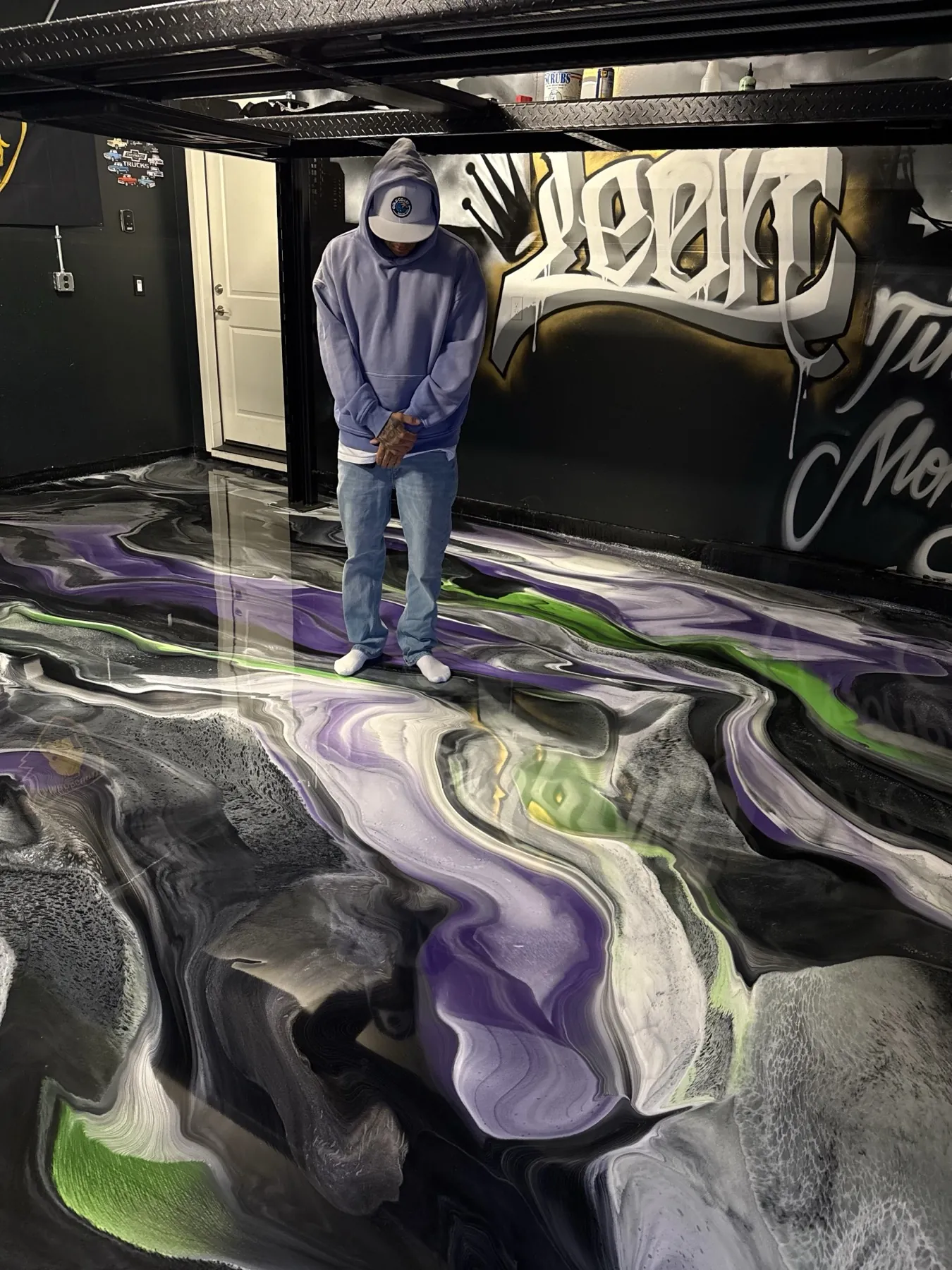
Turlock Garage Floors Built for the Weekend Workshop
A lot of Turlock garages stopped being about the car a long time ago. There is a bench on one wall, a fridge in the corner and a project up on stands in the middle. The floor under all of that takes farm dust, dropped sockets and the weight of a loaded tool chest. Johnny Mendoza tests the slab first, then builds the coating around how the room really gets used.
JP Resin Certified · Don Resin Certified · Based in Hollister
Four ways a garage workshop beats up concrete
Off Monte Vista, out toward Crowell Road and on the newer streets south toward Donnelly Park, a garage that gets used wears in the same few places.
Farm dust
Turlock sits in the middle of open farm ground, and the fine dust off it drifts under the door and rides in on boots and tires. Grit under a shoe acts like sandpaper. A hard clear coat with a little texture takes that grinding without going dull along the walk paths.
Jack stands
A car up on stands rests its whole weight on four small steel feet. On garage paint those feet punch straight through. A full-thickness system bonded into ground concrete spreads that load into the slab, so the finish under each stand stays intact.
Rolling tool chests
A loaded chest is heavy, and its small casters travel the same line from the wall to the car again and again. Soft coatings wear a lane into the floor. A harder topcoat holds up to that path, and a flake blend hides the faint marks between washes.
Oil and fluids
Motor oil, coolant, brake fluid and the odd can of spray paint all land on a workshop floor sooner or later. Bare concrete soaks them in for good. A sealed coating keeps them sitting on top long enough to wipe up with a rag and a mild degreaser.
Irrigated ground under the slab, and why the meter comes out first
Plenty of slabs around the older parts of Turlock were poured straight on grade, with irrigated ground underneath and no vapor barrier between the two. Lawns, gardens and nearby fields keep that soil damp much of the year, and concrete wicks the moisture upward toward whatever sits on top of it.
Bare concrete lets the moisture breathe out without anyone noticing. Seal it under a coating and the water has nowhere to go. It gathers under the film, pushes it up in blisters and breaks the bond, often months after the job looked perfect.
That is why the moisture test happens before any primer is opened. Johnny grinds the slab to a CSP 2 or CSP 3 profile, strips old paint and sealer, chases and fills the cracks, then takes his readings. When the numbers run high, a moisture-mitigating primer goes down first. You hear about it on the day he tests, while the plan can still change.
A slab can look bone dry on top and still be drawing water up from the ground. The meter settles it, not the eye.
Newer houses south toward Donnelly Park get the same test. A newer pour is no promise of a dry one, and the reading is part of every site assessment regardless of the age of the house.
Old oil stains get an honest look at the same visit. Years of drips from a project car soak deep into concrete, so those patches are degreased and ground until the coating can grip there as firmly as it does across the rest of the floor.
Flake, solid or metallic for a floor that gets used
Most working garages end up with a flake floor, and for good reason. The broadcast chips break up the surface, so farm dust, a film of sawdust and the faint ring from a coffee can stay out of sight until wash day. The chips also leave a light texture that gives sneakers some bite when the floor is damp.
A solid color looks sharp, the way a shop floor looks in a catalog. It also shows every footprint and every drop of oil, so it suits an owner who sweeps often and likes seeing exactly where the mess is.
Metallic is the showpiece, like the black, gray, purple and lime green floor in the photo above, under a painted mural wall. It has a depth that flake cannot match. It is smoother and shows dust sooner, which fits a garage that is more lounge than repair bay.
Still torn? Johnny sets sample boards of each on your own concrete so you can judge them in your own garage light.
Pick the finish for the messiest week the garage has, not for the morning after it gets hosed out.
Benches, overhead racks and what has to come out
The garage does not have to be stripped bare. Wall cabinets and steel storage racks hung from the ceiling can usually stay where they are, since the work happens below them. Anything sitting on the floor comes out: the chest, a freestanding bench, the fridge, the bikes and the boxes that have been in the corner since the move.
Bolted benches and rack legs are treated like any fixed base. The coating runs right up to them, and the edge is cut clean and sealed so dust and spilled fluid cannot creep under the film where it ends.
Floor drains, the step up into the house and a water heater platform each get their own detail. Those are the spots where a careless edge starts lifting first, so they get the slowest, most deliberate work of the day.
While the work runs, the door stays down and the cars live on the driveway or the street. Johnny lays out the order of each day before you start clearing shelves, so you know when the fridge can be plugged back in and when the floor is off limits to everyone in the house, the dog included.
A polyaspartic topcoat closes out the system. It cures fast and holds its color in the sun that pours in whenever the door is up, which matters on a west-facing garage. Most owners are pulling back in within a couple of days, and Johnny names the day before work begins.
Systems, flake blends and finish options are laid out in more depth on our garage coatings page.
What garage owners ask Johnny
Will the coating hold up under jack stands?
Yes, on a properly built floor. The coating is bonded into ground concrete at full thickness, so the load from each stand spreads into the slab instead of punching through a thin film. Setting every stand on a square of plywood is still a good habit and protects the finish.
Does the whole garage have to be emptied?
Everything sitting on the floor comes out, including the tool chest, the fridge and the boxes in the corner. Wall cabinets and ceiling racks usually stay put. Bolted benches can be coated around and sealed at the base. Johnny walks the room with you so nothing surprises anyone on install day.
Why test for moisture when Turlock is so dry?
Dry air says little about the ground under the slab. Many older Turlock slabs sit on irrigated soil with no vapor barrier, and that water rises into the concrete. A sealed coating traps it and blisters. The reading tells Johnny whether a moisture-mitigating primer has to go down first.
Is flake or metallic better for a workshop?
For a garage that sees real repair work, flake is the forgiving pick. It hides dust and small stains and carries a little texture underfoot. Metallic suits a garage that is mostly a hangout and gets swept often. Both start with the same grinding, crack repair and moisture test.
Will the floor be slick when it gets wet?
Any smooth, glossy floor gets slicker with water on it. Flake floors carry natural texture from the chips, and grit can be mixed into the clear coat along walk paths, at the door into the house and around the bench. You decide how much grip you want before the topcoat goes on.
How soon can the cars go back in?
The polyaspartic topcoat cures quickly, so most owners are parking again within a couple of days. Light foot traffic comes sooner. Heavy tool chests and jack stands wait a little longer. Johnny gives you the timing for your own garage at the site assessment, before anything is put on the calendar.
Get Johnny into your garage
Tell him how big the garage is, what lives in it and what you work on out there. Johnny drives up from Hollister, runs the moisture test, checks the cracks and the oil spots, and brings flake and metallic samples to set down on your concrete. The site assessment is free.
Finished garages and more are in the gallery. Writing is easier? Drop Johnny a note listing the bay sizes and what lives in the garage, and Johnny will reply.