Picking a Flake Blend That Hides Modesto Dust
Most people choose a flake blend off a sample board in about four minutes. In this valley the blend is doing practical work: hiding agricultural dust, holding up under strong light, and deciding how the floor feels underfoot. Here is how Johnny walks a Modesto client through that choice.
Flake is the system that goes into most Modesto floors, and the reason is practical rather than decorative. This valley is dusty, bright and hot, and a chip pattern handles all three better than a solid color ever will. Once you have decided on flake, though, two choices are left and they matter more than clients expect: how big the chip is, and what colors go into the blend. Both of them change how the floor lives, not only how it looks.
Agricultural Dust Is the Local Design Constraint
Modesto air carries fine agricultural dust for most of the year. It comes in on shoes, on tires, and through a garage door that opens twice a day, and it settles on every floor whether the room is sealed or not. Nobody chooses a floor because of that, and yet it is the thing that determines whether you are satisfied with the surface two years from now.
A solid color announces settled dust every single day. Light falls across a flat surface, the film of dust reads as a haze, and the floor looks dirty forty-eight hours after you cleaned it. A chip pattern does the opposite. The eye reads the pattern first and the film second, so a flake floor still looks right in year three when a plain one looks tired.
Blend color pushes the same lever. A mid-tone blend hides the fine dust better than either a very light or a very dark one, because the pale extreme shows every dark speck and the dark extreme shows every pale one. Mid-tone also stays cooler underfoot in a bay that runs hot through August, which is a real comfort difference in a Modesto garage in the middle of summer.
Chip Size Changes How the Floor Behaves
Chip size is where the practical tradeoff lives, and it is a bigger decision than the color. Larger chip in a high-contrast blend hides more, gives a coarser texture, and reads as a distinctly patterned floor across a room. Smaller chip in a tighter blend reads closer to a solid color, feels smoother underfoot, and shows more of what lands on it.
For a garage we push toward the larger end almost every time, because hiding wear and dust is most of the reason people buy a flake floor at all. The coarser texture is also genuine grip, which counts when a car pulls in wet during a winter storm and somebody steps out onto the slab.
The rooms that argue for a smaller chip are the ones people cross barefoot. A covered patio stays in shade but still takes real heat, and it gets a smaller chip with an extra topcoat, which fills between the pieces and smooths the surface without losing the traction. Same logic in a home gym where people work on the floor. Tell us what actually happens in the room and it gets specified for that rather than for a catalog page. The systems are laid out on our Modesto flake epoxy page.
Texture Against Cleanability, the Honest Version
There is a real tension here and it is worth stating plainly. Every bit of texture you add for grip and dust-hiding is a bit of texture that a mop has to work across. A coarse broadcast under a normal topcoat has microscopic relief between the chips, and fine dust settles into it rather than sitting proud on a flat plane.
What resolves the tension is topcoat thickness rather than chip size. Two clear coats over a full broadcast build a level surface across the top of the chips, so the floor keeps the visual pattern and the grip while cleaning down with a dust mop and a damp pass. A thin single topcoat is what leaves an aggressive floor that catches everything, and it is one of the reasons a cheap flake quote comes back to bite.
That is the practical answer for a valley house. Take the pattern for dust-hiding, take the chip for grip, and buy the clear coats that make the whole thing wipe clean. Skimping on the topcoat to afford a fancier blend is the wrong trade every time.
Full Refusal Is What You Are Actually Buying
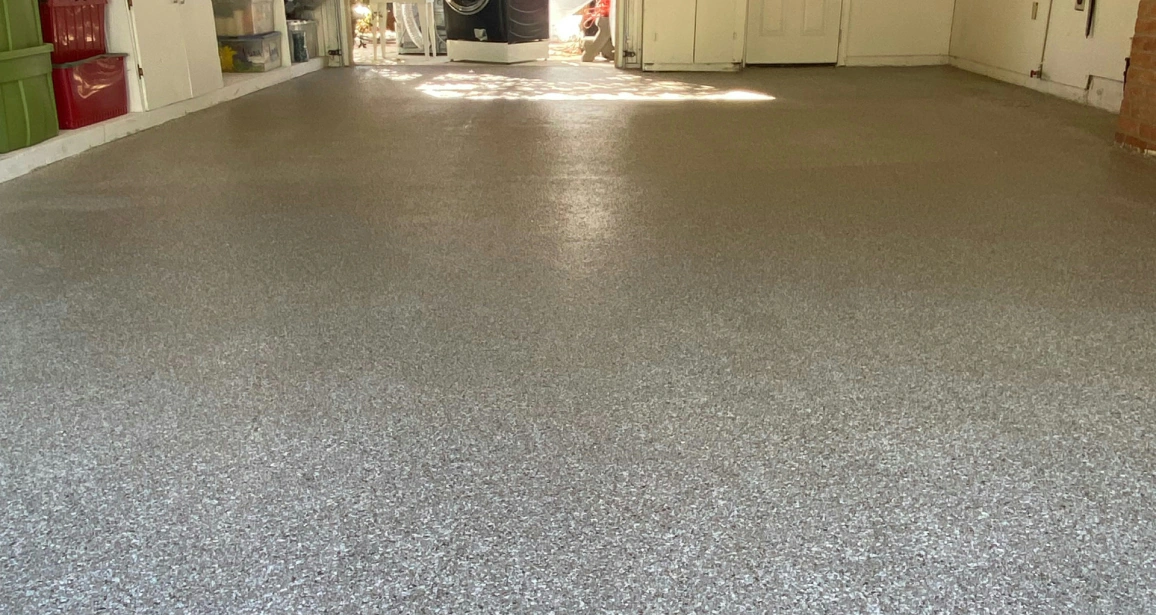
Before the blend matters at all, one thing decides whether the floor lasts. Full refusal means chip is broadcast until the surface physically will not take any more and no base coat is visible anywhere. Anything less is a partial broadcast, where chip is scattered decoratively and base coat shows between the pieces.
That distinction is where the cheap flake numbers in this city come from. A partial broadcast uses a fraction of the chip and half the scraping labor, and it looks perfectly fine the week it goes down. The exposed base coat between the pieces is the weak point, and it wears through first in the traffic lanes, usually right where the car doors open. Two or three years later there is a visible path across the floor.
So when you collect numbers, ask how much chip goes down per square foot and whether base coat will show anywhere. A full refusal answer is a specific weight and a flat no. Both quotes will still say flake, which is exactly why the question is the useful one to ask.
Strong Valley Light and the UV Question
The last piece is light. Modesto sun is strong, and anything getting real exposure takes a UV-stable topcoat as standard. A patio, an entry, a room behind glass, or a garage where the door stands open half the day all qualify. A standard clear coat ambers under that light, which shows badly on a light blend and turns a cool gray selection warm within a year or two.
This is worth being specific about when you plan the job, because the answer is different for different parts of the same property. Sit down and work out which surfaces genuinely see direct sun, then spec those separately rather than blanketing the whole property with the more expensive option or, worse, blanketing it with the cheaper one.
Johnny brings samples out to the room for exactly this reason. A blend reads completely differently across a whole floor under real light than it does in your hand under a showroom bulb. See finished blends in the gallery, or call (650) 797-3040 for a free look at the slab.
Flake Questions We Get in Stanislaus County
Does a flake floor hide valley dust or collect it?
It hides it. The chip pattern breaks the surface up visually, so settled dust stops reading as a film across the room the way it does on a solid color. It still cleans with a dust mop. In a valley climate that is a real difference in how often the floor looks like it needs attention rather than a cosmetic preference.
Is a flake floor rough on bare feet?
That depends on chip size and how heavily we topcoat. A garage takes a coarser texture on purpose. A covered patio people cross barefoot gets a smaller chip and an extra clear coat, which fills between the pieces and smooths the surface without giving up the grip. Tell us where the floor is and it gets specified for that room.
Can a damaged flake floor be repaired?
Yes, and it is the main practical advantage over a poured metallic floor. The chip pattern is random, so a damaged area gets ground back, re-broadcast and topcoated, and the repair disappears into the surrounding pattern with no visible boundary. That matters in a garage where something eventually gets dropped.
Comparing options? Read how flake sits alongside garage coatings and metallic, or tell Johnny about your room.
See the Blends on Your Own Floor
Johnny brings chip samples to the room, reads the slab, and puts a firm price to the work before anything starts. Booking a walkthrough takes one call.
Call (650) 797-3040