Coating a Restaurant Floor Without Losing a Weekend
A dining room that goes dark on a Friday night loses real business. The floor can go in on closed days and overnight instead, if the job is planned around the way the room runs.
Most restaurants and bars have one or two days a week when the doors stay shut, plus a few hours each night between the last cleanup and the morning delivery. That is the window a floor has to fit into. Johnny plans the job backward from the day the room has to open again, then works out how much can be ground, coated and cured inside each stretch. Some rooms get done in one long closed stretch. Others go section by section over two or three weeks without missing a service.
Start with the day the room reopens
The first question Johnny asks is not about color. It is when the room has to be full again. A bar that does most of its business Thursday through Saturday has a different window than a breakfast place that closes Mondays, and the schedule drives which system makes sense.
Polyaspartic topcoats are the reason closed-day installs work at all. They cure fast enough that a coat laid in the evening can take foot traffic by morning, where a slower epoxy topcoat would keep the room shut for longer. The base coats still need their time, so the plan sets those down at the start of a closed stretch and finishes with the fast coat at the end.
Write down your real closed days, the delivery schedule and when the cleaning crew comes in. Johnny lays the work out on that calendar before anything else gets decided, and he tells you up front if the room needs one extra night to do it properly.
Splitting the room into sections
When a restaurant cannot close for more than a day at a time, the floor can be done in pieces. The dining room goes first on one closed stretch while the bar keeps running, then the bar side gets its turn the following week. A temporary barrier and a clean edge between sections keep the two halves from looking patched.
Where that seam lands matters. Johnny tries to put it somewhere the eye already expects a change, like a step, a doorway or the line of the bar front, so the joint reads as part of the room. A metallic finish makes that harder than a solid color, because the pattern has to carry across the line.
Kitchens and service lanes are often their own phase. They take the most abuse, they are the hardest rooms to empty, and they may need a different system than the dining side. Planning them as a separate step keeps the front of house on schedule.
Grease, mop water and the service lanes
The path between the kitchen pass and the tables takes spilled drinks, dropped food and a mop every night. Grease tracks out of the kitchen on shoe soles and settles along that lane, which is why it is usually the slickest strip in the building.
A traction additive mixed into the topcoat gives those walkways some grip without making the whole floor feel rough. Johnny usually concentrates it where servers walk fast with full trays: behind the bar, at the kitchen door and along the route to the dining room.
The base of the wall matters as much as the floor. Mop water runs to the edges and sits in the corner where floor meets wall, and over time it gets under baseboards and rots them. A cove base carries the coating a few inches up the wall with a rounded corner, so water has nowhere to settle and the mop reaches everything. Our restaurant flooring page for Turlock has the details on that system.
Chairs, table legs and the furniture shuffle
Dining chairs get pulled out and pushed in hundreds of times a night, and most of them drag rather than lift. Bare metal glides and worn plastic feet scratch a finish faster than foot traffic does, especially with grit under them.
Fresh felt or soft glides on every chair before the room reopens is the cheapest protection a floor can get. Check them a few times a year, since a glide that falls off leaves a bare metal tip that will scratch a clear coat in a single service.
Booths and bar stools bolted to the floor need a plan before the job. Some can come up and go back down after the coating; others stay and get coated around. Johnny walks the room with you and marks which pieces move, so nobody is unbolting a booth at midnight with the crew waiting.
Warm metallics against wood walls
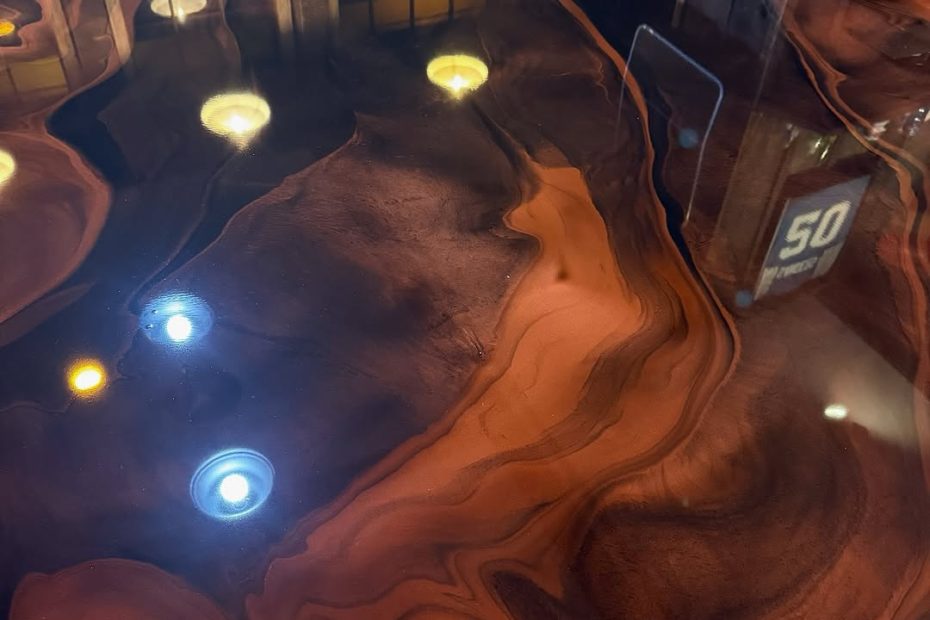
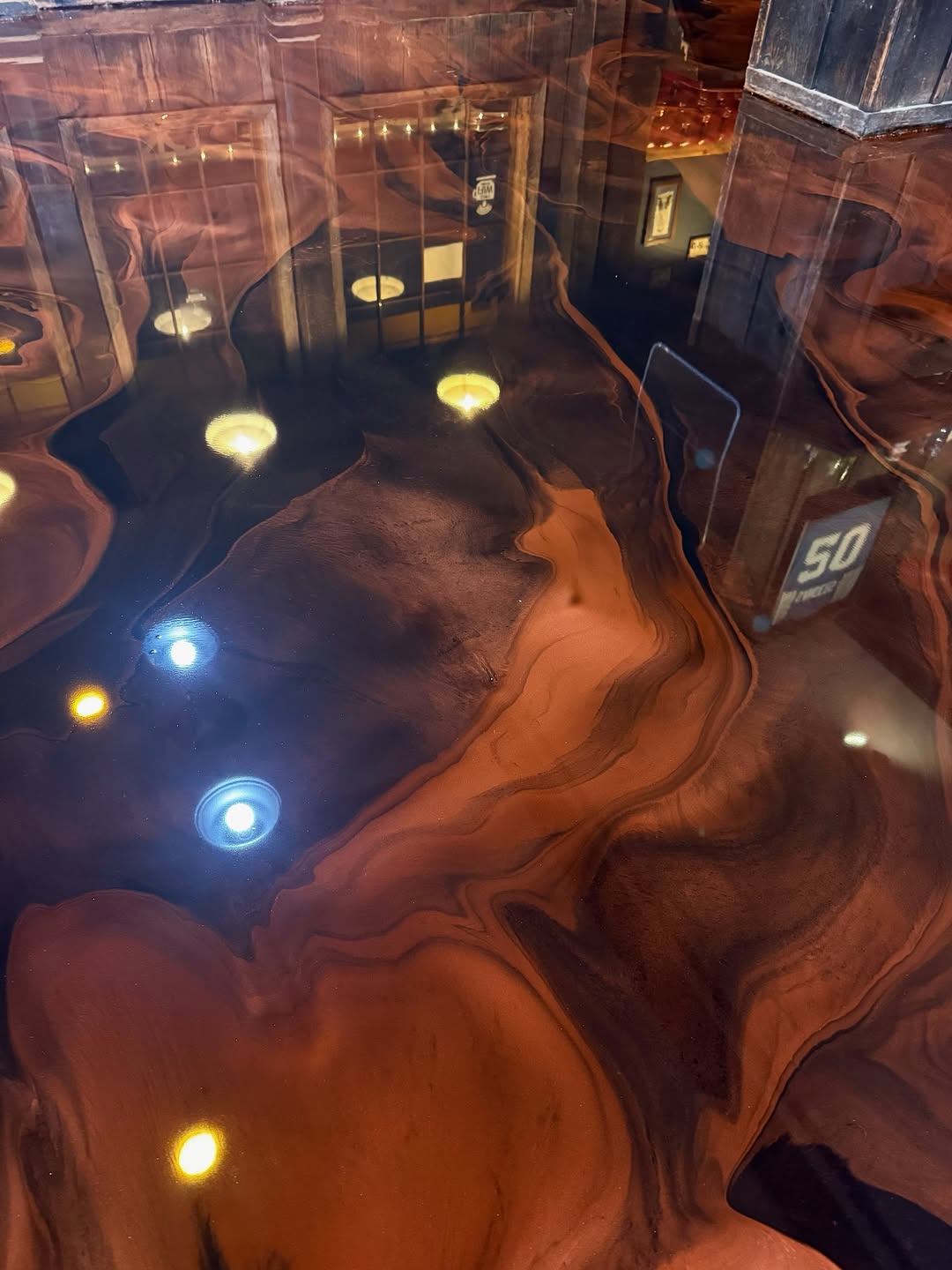
A bar paneled in dark wood, like the one pictured, is usually a dim room with low lights and windows facing the street. A copper or bronze metallic tends to sit well in those rooms, picking up the warm tone of the wood and catching the ceiling lights without looking out of place.
A darker floor also hides the evening’s traffic better than a light one. Spills and scuffs show less on black and copper than they do on silver or white, which matters in a room that only gets a full clean after closing.
Like any metallic, the color is easiest to judge in the room itself. Johnny brings samples and leaves them on the floor through a service, so you see them under the lights you use at night and in the daylight from the front windows. If you also run a lunch crowd, look at them at noon too.
Questions restaurant owners ask
Can the whole floor go in over one closed day?
Small rooms sometimes can, with a long overnight on either side of the closed day. Larger dining rooms usually need two or three separate windows, done one section at a time, and most bars fall somewhere in between. Johnny measures the room and looks at your calendar first, then tells you how many stretches it will take before anyone commits to dates.
How soon can staff walk on the new floor?
A polyaspartic topcoat takes foot traffic within hours, so a coat laid after closing is usually ready for the morning crew. Tables, chairs and heavy equipment wait a little longer. Johnny gives you a time for each on the day of the install, based on the room temperature and the system used. Plan the first service a little lighter if you can.
Will the traction additive make the floor hard to mop?
Not with the amount used in walkways. It adds grip you can feel under a shoe without catching a mop head. Most owners keep the smoother finish under tables and put the texture where servers move fast. A sample patch on the slab lets you run a damp mop over it and feel the difference before the job starts.
Johnny drives up from Hollister for Turlock dining rooms and bars. Look over the Turlock page and the restaurant flooring system, send Johnny your closed days, or call (650) 797-3040. Opening a shop next door instead? The retail flooring page is the better read.
Send the calendar first
Johnny looks at the room, the service lanes and the days you are closed, then lays out how the floor fits around them. There is no charge for the site assessment.
Call (650) 797-3040