What a Week of Haircuts Does to a Barbershop Floor
Hair, chair bases, rolling stools and a steady drip of product and disinfectant. A barbershop floor takes a beating every day, and the shop usually cannot close for long while it gets redone.
A barbershop is one of the hardest small rooms to floor well. The floor gets swept a dozen times a day, rolled over from open to close, and splashed with things that stain. In a small town most shops run on regulars, and regulars do not wait a week for a shop to reopen. If your shop is in one of the older storefronts downtown, the slab under the current floor may also be more patched than it looks. Johnny starts with the chairs, the stations and the schedule, and gets to color last.
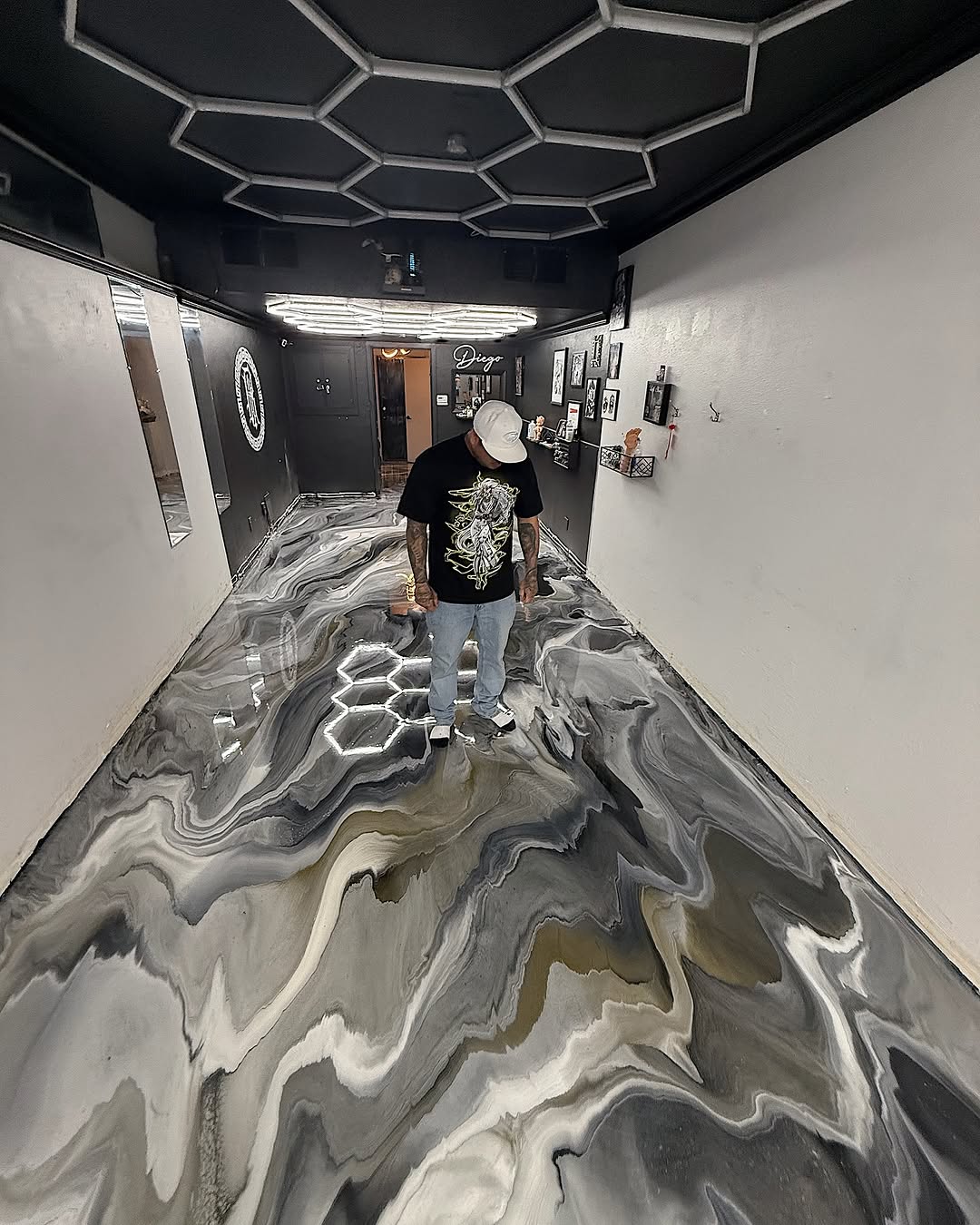
Hair, a broom and a floor with no seams
Clipped hair is fine and it travels. On tile it packs into the grout lines, and on sheet vinyl it works under lifted edges and seams near the stations. By the end of a busy Saturday it is in every crack the floor has.
A resin floor gives it nowhere to go. The coating goes down as one continuous surface, so a broom or a dust mop pushes everything into a single pile. Where the floor meets the wall, the coating can turn up a short way so hair does not pack into that corner either.
The finish changes how hair looks between sweeps. A mid-tone metallic or a flake blend hides a light dusting better than solid black or stark white, both of which show every clipping. Gloss shows hair too, because it catches the light. Some owners want a dark, glossy floor anyway because it looks sharp in photos, and that works fine as long as someone sweeps between clients.
Chair bases bolted to the slab
Barber chairs are heavy, and most are bolted through their base plates into the concrete. That raises the first real decision: coat around the chairs, or take them up and coat underneath.
Coating around a fixed base is quicker, but it leaves an edge at every chair where the new floor stops. Over time that edge is where hair, product and water collect. Pulling the chairs, coating the full floor and reinstalling them on the finished surface gives a cleaner result, and a chair can be moved or swapped later without exposing bare concrete.
When a base comes off, the old bolt holes get cleaned out and filled before any coating goes down, then redrilled through the cured floor when the chairs return. Johnny talks that through with the owner and whoever sets the chairs, so nobody hears about the plan for the first time on the morning of the job.
Rolling stools are the other daily load. Small casters under a seated barber put weight on a tiny point and travel the same short path all day. A properly bonded system handles that, though cracked casters are worth replacing so they roll instead of drag.
Color, product and disinfectant on the floor
Every shop spills. Hair color, pomade, styling spray, aftershave and the disinfectant the combs soak in all reach the floor sooner or later. Bare concrete drinks them in and keeps the stain, and vinyl can discolor around the stations where drips land every day.
A sealed resin floor holds spills on the surface long enough to wipe up. Dye is the one to move on quickly, since some colors can leave a faint shadow on a light finish if they sit overnight. Disinfectant at normal strength does not bother a cured clear coat, though a puddle left under a station all weekend is worth catching.
Daily care is a sweep, then a damp mop with a mild cleaner. Harsh solvents and abrasive pads dull a finish faster than foot traffic does, so keep the floor supplies apart from whatever gets used on the tools. A metallic also tends to hide small spots in its movement, where a flat solid color shows them right away. The layout for shops like yours is on our barbershop flooring page for San Juan Bautista.
Getting the shop back open fast
Downtime is the worry most barbers bring up first. A shop that closes for a week can lose clients to the next chair down the road. So the work gets planned around the days the shop already closes, with nights added where the space allows.
Prep comes first, and it is the dusty part. The old floor comes up, the slab gets ground, and anything hollow or cracked gets repaired. In a small storefront the work area is closed off and vacuumed before the base coat is mixed, and during harvest the front door stays shut so field dust does not settle in the wet coat.
The polyaspartic topcoat is what makes a short closure possible. It can be walked on the same day, so a shop can often be swept and crossed before the chairs go back. If the old slab turns out to need more repair than expected, Johnny says so before the coating starts, not after.
An accent in the floor
A barbershop is one of the few commercial floors where the owner gets to have some fun. The shop’s colors can run through a metallic pour, or a darker band can mark the walkway from the door to the waiting chairs. An inlay at the entry is another option, set into the floor and sealed under the same clear coat so it wears along with everything around it.
The best accents are simple. A floor with one idea reads better than a floor with five, and a shop with stations along one wall usually looks best with the metallic movement running the length of the room. Johnny puts samples on the real slab so you can judge them against your mirrors and chairs instead of on a phone.
Anything set into the coating is sealed level, so a broom crosses it without catching. In older buildings, grinding also reveals the patches behind the storefront, and a metallic or a flake can either hide them or work them into the design.
Questions barbers ask
Can the coating turn up the wall behind the stations?
Yes. The coating can run a short way up the base of the wall as a cove, so floor and wall meet in one curve instead of a corner. Hair, product and mop water have nowhere to pack in behind the stations, and a broom or dust mop pulls everything out of that edge in one pass instead of leaving a gray line along the baseboard.
Does a dark gloss floor show hair between sweeps?
It does. Solid black, stark white and high gloss all show every clipping, because gloss catches the light and hair sits right on top of it. A mid-tone metallic or a flake blend hides a light dusting much better. Some owners still pick dark and glossy because it photographs well, and that works fine with a quick sweep between clients.
What happens to the old bolt holes when the chairs go back?
They get cleaned out and filled before any coating goes down, so the new floor runs over them as one surface. Once the coating has cured, the chairs are set back where they belong and new holes are drilled through the finished floor. Johnny goes over the layout with whoever sets the chairs beforehand, so a station can also move if the shop wants a new arrangement.
Gold Coast Resin is based in Hollister, roughly fifteen minutes away on Highway 156. See the San Juan Bautista overview, tell Johnny how many chairs you run, or call (650) 797-3040.
Count the chairs with Johnny first
He looks at the slab, the chair bases and your calendar, then works out how to keep the closure short. The site assessment is free.
Call (650) 797-3040