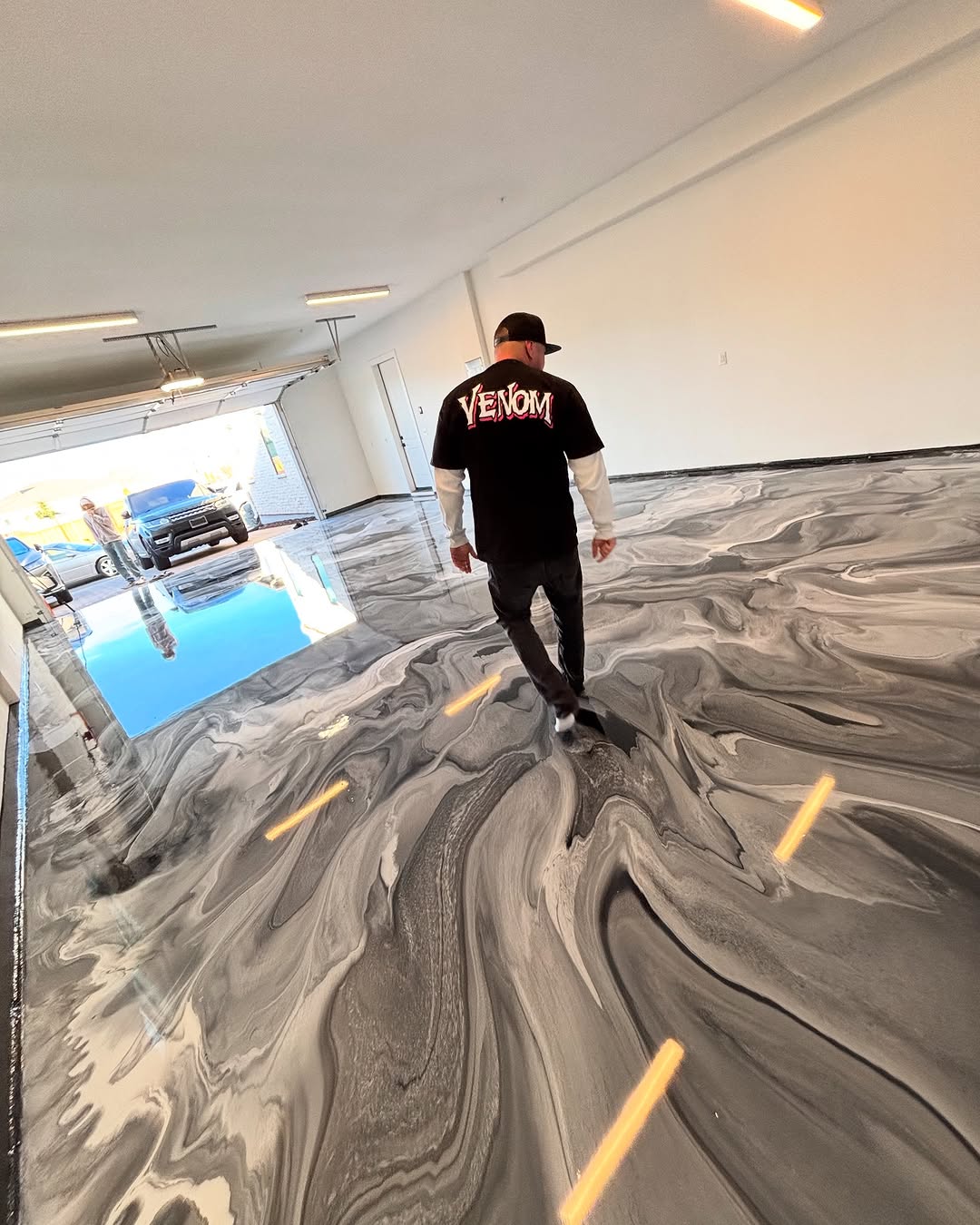
Polyaspartic Floors for Ridgemark Walk on Them Tonight
Polyaspartic cures in hours, keeps its color where sun pours through an open bay door, and keeps curing on a cold winter slab. The catch is a short life in the bucket, so the speed you enjoy afterward gets paid for in how tightly we run install day.
Trained by JP Resin and Don Resin · A short drive up from Hollister
When a week of downtime is the problem
Polyaspartic earns its place wherever the calendar or the sun is working against a standard epoxy system. Four situations come up again and again.
Bays that face the sun
A garage door that stays rolled up through the afternoon puts direct UV on the front few feet of floor, and standard epoxy yellows there first. Polyaspartic holds its color through the chemistry itself, with no extra protective coat needed.
Garages you need back fast
Family arriving Friday, a cart with nowhere else to sleep, a car that cannot sit on the driveway all week. Grind and coat in a day, walk on it that evening, and pull in the morning after.
The clear coat over flake
This is where most of ours go. A chip broadcast gives the floor body and grip, and the polyaspartic clear on top locks the chips down while bringing its fast cure and sun resistance along with it.
Winter installs
A cold January slab can leave epoxy sitting soft far longer than its label claims. Polyaspartic keeps reacting at temperatures that stall epoxy, so a winter job does not have to slide back a week.
Reading the slab before the bucket opens
Polyaspartic is a polyurea chemistry. The quality that makes it attractive, a cure measured in hours, also means it starts reacting the moment the two parts meet. On a mild morning a practiced crew has enough time to roll out a garage without rushing. On a hot afternoon it has far less, and the warning signs are easy to miss until the material starts dragging under the roller.
Ridgemark summers are warm and dry, and the concrete inside a closed garage banks that warmth. By late afternoon the slab can sit well above the air around it. So before anything gets mixed, an infrared thermometer goes onto the floor in several spots: by the door, in the middle, and back against the house wall. Where the sun hits the door end, those readings often disagree.
The readings set the plan. A warm slab means smaller batches, more hands on rollers, and a start early enough that the coat is finished before the concrete heats up again. We would rather push a start time back than wrestle chemistry that is already setting in the tray.
Winter flips the problem around. Clear nights in the foothills pull heat out of a slab, and cold concrete slows every coating on the market. Epoxy can stay tacky long enough to collect dust and the odd footprint. Polyaspartic keeps reacting at those temperatures, which is a big reason we reach for it as the clear coat when a job lands in the cooler part of the year.
Sunlight is the third variable. The strip of floor just inside a garage door gets more UV than the rest of the house combined, especially with the door up while someone works in the bay. An epoxy clear there slowly goes amber, and the line where the sun stops becomes visible. A polyaspartic top layer keeps the front of the floor matching the back.
Your part of a one-day job happens the night before. The garage needs to be empty down to the bare slab: shelving units pulled out or lifted off the floor, the cart parked somewhere else, anything leaning against the walls moved away. When we arrive to a clear bay, the grinder starts right away and the whole schedule holds. When half the morning goes to shifting boxes, the coating slides toward the hottest part of the afternoon.
While the coats go down and first set, the big door stays closed. Foothill dust, dry leaves and the occasional curious bug all land happily in a wet clear coat, and a fast cure fixes them in place just as fast. We ventilate through a side door and keep traffic out until the surface skins over, which on this chemistry is a matter of hours.
Grip is worth deciding up front. A smooth polyaspartic clear is slick once water gets on it, and a cart coming in off wet grass carries plenty. We can blend a fine grit into the final coat so tires and shoes have something to hold. Upkeep afterward is simple: sweep grit out regularly, since grit under a tire is what dulls any clear coat over the years, and a damp mop handles the rest.
None of the speed comes from skipping prep. The slab still gets a full diamond grind, cracks still get repaired, and a moisture test still happens before any coating is opened. A garage set into a slope can read damp while the house beside it reads dry. A high number means a moisture-mitigating primer, priced in at the start, and a longer install day.
Most of our polyaspartic goes over a chip floor, covered in detail on the flake epoxy page, and the garage coatings page walks through which system suits which kind of bay. The chemistry itself is explained on our main polyaspartic coatings page, and every local service is gathered on the Ridgemark page.
Polyaspartic or epoxy: picking the top layer
We install both. The choice comes down to what sits underneath the clear coat and how the room gets used day to day.
Over a flake broadcast
Polyaspartic, nearly every time. The chips supply thickness and texture, and the clear coat supplies fast cure and UV resistance. It is the combination we install most in garages around Ridgemark.
Solid color on its own
A single solid-color system suits a service room or shop space that has to reopen quickly. Those rooms have their own demands, which the commercial coatings page covers.
Where epoxy stays the call
A decorative metallic floor needs resin that stays open long enough to shape the pattern. Polyaspartic sets too fast for that work, so the metallic layer stays epoxy.
A slab that tests damp
Moisture decides which primer goes down first. The mitigating primer has to cure before the finish goes over it, so a damp slab adds time to the day whichever top layer you pick.
What people ask before a one-day floor
Can I really park on it the next day?
For an ordinary two-car garage in decent shape, usually yes. We grind and repair in the morning, roll the coats after lunch, and you can walk across it that evening. Cars go back in the following day. Deep cracks or a damp slab add prep time, and we flag that at the site assessment so install day holds no surprises.
What if the install lands on a hot week?
We start early, read the slab temperature before mixing, and cut batch sizes so each one is down on the floor before it thickens. If the concrete is still too hot, the start time moves. Rolling polyaspartic that has already begun to set leaves lap marks you would notice every time the garage door goes up.
Does cold weather stop the install?
Rarely. Cold slows every coating, but polyaspartic keeps curing at slab temperatures that would leave epoxy soft for days. On a winter job we still check the slab temperature against the dew point before starting, because condensation sitting on concrete ruins adhesion no matter which chemistry goes over it.
Will the strip by the open door turn yellow?
It should not. Standard epoxy ambers where sunlight reaches it, and the front few feet of a garage take the most. Polyaspartic resists UV through its chemistry, so the floor at the door stays the same color as the floor against the back wall. That is one of the main reasons we choose it as the top layer.
Why not use polyaspartic for everything?
Its short working life rules it out for decorative work that needs time, such as a metallic pour that has to be moved and shaped by hand. The material also costs more. For a garage with no deadline and little sun on the floor, a well-built epoxy system can be the smarter spend, and Johnny will tell you so.
Is a faster floor a thinner floor?
It does not have to be. Build comes from the system: a base coat, a full chip broadcast when you want flake, and a clear coat over the top. Polyaspartic changes how soon each layer is ready for the next. The grinding, crack repair and moisture testing stay exactly the same on a one-day job.
Tell Johnny when you need the garage back
Call, or use the contact page, and give us the date the floor has to be usable. The site assessment is free: Johnny checks the slab temperature and moisture, looks at how much sun reaches the bay, and tells you whether a one-day polyaspartic job fits or whether a slower system suits the space better.
Finished floors are in the gallery, or send Johnny your dates.