Pouring a Metallic Floor When the Slab Reads 100
A metallic floor is a chemical reaction you get one attempt at, and Central Valley heat shortens that attempt considerably. The pattern is decided in about fifteen minutes by two people working the material, so everything about a Modesto pour is built around protecting those minutes.
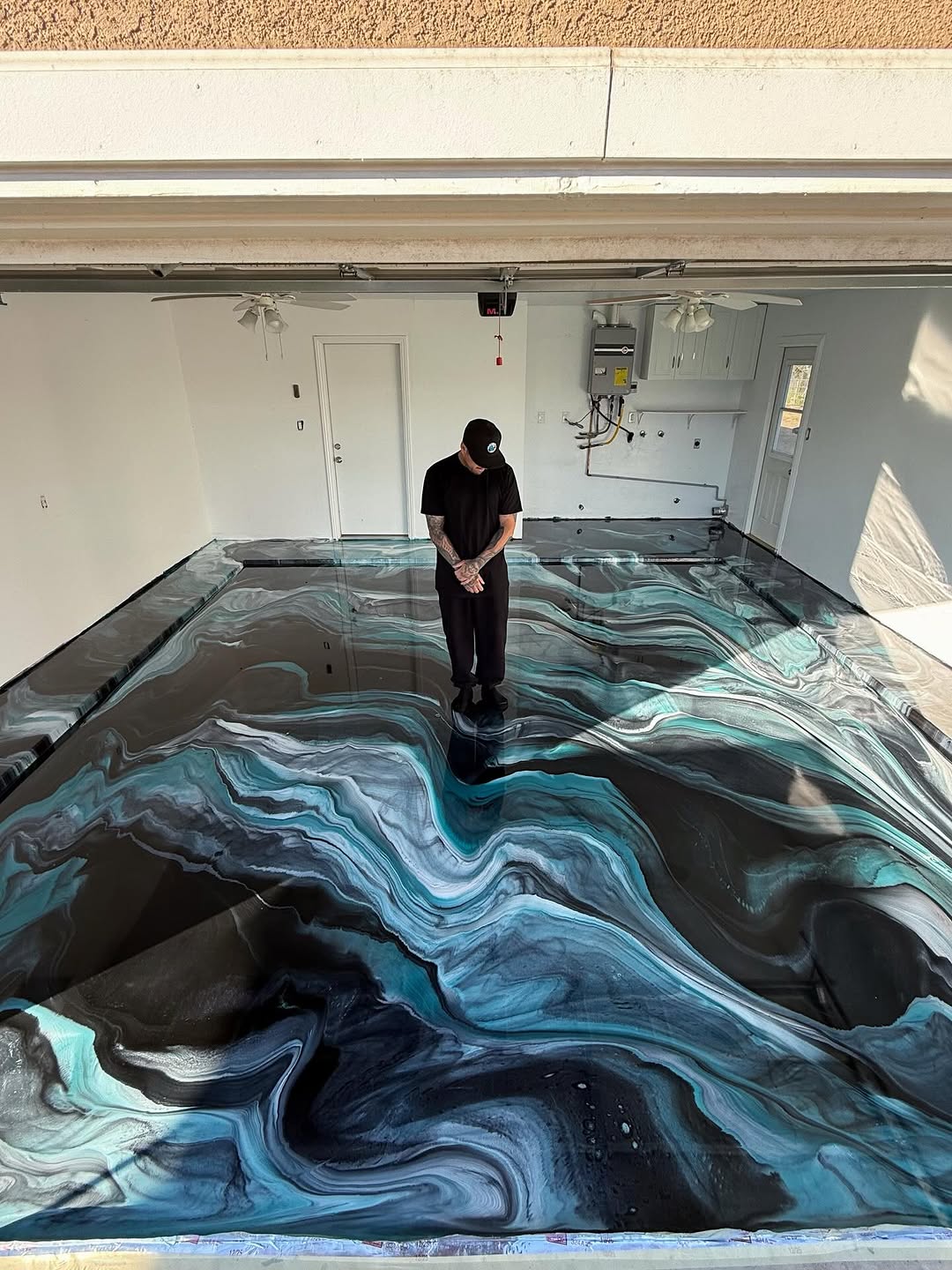
Metallic is pigmented resin carrying metallic particles that migrate as the resin moves and settles. Where the film is deeper the color pools darker, where it thins it lightens, and dragging a tool through it moves the particles with the current. What ends up on your floor is a record of that movement, frozen the moment the resin gels. In a valley where a slab holds ninety degrees into the evening, when the resin gels is the whole question.
Heat Turns Half an Hour Into Eighteen Minutes
Resin cures on a chemical reaction, and heat drives that reaction hard. A metallic base that gives a comfortable half hour of open time in a mild garage can drop to eighteen or twenty minutes on a July afternoon in Modesto. Twenty minutes is not enough time to move pigment across a full two-car floor before the material starts to set, and everything you fail to reach in that window stays the way it landed.
That is the difference between a metallic floor and every other coating we install. A flake floor that took an extra hour looks the same as one that went smoothly. A rushed metallic pour looks rushed permanently. You can see it in the pattern: the movement gets tighter and more anxious toward the end of the room, because that is exactly what happened.
So the answer is never to work faster. Johnny adjusts the conditions instead. That means first-light starts, product held cool until the moment it goes down, the floor broken into smaller worked sections rather than treated as one open field, and a slower-setting formulation when the forecast demands one. The full approach sits on our Modesto metallic epoxy page.
Why a Modesto Metallic Job Starts Before Sunrise
An early start is not about crew preference. It is about catching the slab at the coolest point of its cycle. Concrete lags the air temperature, absorbing heat all through a hot afternoon and releasing it slowly overnight, so the surface is at its lowest reading in the hours around dawn and climbing steadily from mid-morning on.
Pouring into that early window buys back working minutes that no product choice can buy. It also means the material is not fighting a rising slab temperature halfway through the room, which is what causes a pattern to read differently at one end than the other. Consistency across a floor comes from consistency in the conditions underneath it.
The practical version for a client is simple. If we are pouring a metallic floor in your Modesto garage in July, expect the crew early and expect the space to be genuinely available at that hour. Cars out, doors clear, nothing stored on the slab. Losing the first thirty minutes to moving boxes costs a share of the pour window that cannot be recovered later in the day.
You Get One Attempt, and That Shapes the Recommendation
There is no touch-up on a metallic floor. A damaged section cannot be blended, because the pattern around it cannot be recreated by anyone, including the person who poured it. A gouge means re-pouring that section and living with a visible boundary, or re-pouring the room.
That should be understood before buying rather than discovered afterward. For a showpiece garage, a lobby, or a showroom floor where damage is unlikely, metallic is the right system and nothing else looks like it. For a workshop that takes dropped tools and dragged equipment, we steer clients to flake instead and explain exactly why, because flake repairs invisibly into its own random pattern.
The same honesty applies to matching. We can match a palette, a contrast level and a general character. The exact figure is decided in the room on the day. Anyone promising to reproduce a specific photograph is describing something the chemistry does not do.

Strong Light Through Glass Is the Other Valley Variable
Modesto light is strong, and standard epoxy ambers under UV. On a light metallic pour that shift is obvious, because the whole point of the floor is a specific palette and a warm cast rewrites it. Anything taking direct sun through a window, a glass door, or an open garage door gets a UV-stable topcoat as standard for that reason.
This matters most in the rooms where metallic actually belongs. Entryways, home gyms, offices and lobbies tend to be the brightest rooms in a building, and showroom space along McHenry is often glass across the front. Those are exactly the floors that will show ambering, and exactly the floors somebody bought for their appearance.
The topcoats do more than protect color. They are what you actually walk on and what takes the abrasion, so gloss level and scratch resistance get decided there rather than in the metallic layer underneath. If a room stays dry we usually leave the surface smooth. In a garage where a car comes in during rain we add a fine texture, which costs a little clarity in the reflection and makes the floor safe to stand on.
Where Metallic Earns Its Place in This City
Metallic pays off in the large newer garages on the east side and in the showroom floors along McHenry. Those rooms have the light and the sightlines that make a poured floor worth what it costs, and a reflective surface under product does a lot of the lighting work in a retail space. Interior rooms, entryways and lobbies are the other natural fit, though those need the substrate question answered first.
In a detached shop bay behind an older house, with one window and equipment living on the floor, the same money buys a better outcome as a flake system, and we say so. That is not modesty about the product. It is that a showpiece system in a room nobody looks at is money spent in the wrong place.
Figure three to four working days for a normal room with cure time between coats, light foot traffic usually the day after the final topcoat, and vehicles after about a week in a garage. Finished pours are in the gallery, or call (650) 797-3040 for a free look at the slab and a firm price.
Metallic Questions From Modesto Clients
Can you match a metallic floor I saw online?
We can match the palette and the general character, not the pattern. The veining comes from how the resin moves in the first fifteen minutes and it is genuinely unrepeatable, including by whoever poured the original. Anyone promising an exact match is telling you what you want to hear rather than how the product works.
Does Modesto heat cause problems on a metallic pour?
It compresses the working window rather than ruining the floor, as long as the crew plans for it. A slab at valley summer temperature makes the resin gel considerably faster, so we pour early in the day or bring cooling into the space. A crew that opens the product at noon in August is how a metallic floor goes wrong.
Will a metallic floor yellow in valley sun?
Standard epoxy ambers under UV and the light here is strong. Any floor taking direct sun through a window or an open garage door gets a UV-stable topcoat as standard. If somebody prices a metallic floor for a sunlit room without mentioning UV, that is a genuine gap worth asking about before you sign.
If the room takes real use, compare flake or a commercial specification instead, or describe the room to Johnny.
Talk Through a Metallic Pour With Johnny
Tell him the room, the square footage and what happens on the floor. He will say honestly whether metallic is the right call or whether another system serves you better.
Call (650) 797-3040