Ridgemark Commercial Floors Worked Around Your Open Hours
A golf community runs on small commercial rooms most visitors never notice: the prep room behind a dining counter, a little shop, the barn where carts get washed and charged, a maintenance bay out back. Johnny Mendoza asks what each floor deals with before he picks a system for it.
JP Resin Certified · Don Resin Certified · Based in Hollister
Small rooms that take hard use
Ridgemark is mostly homes, and the commercial floors that serve it are rarely big. That fools people into treating them like residential jobs. A service room that gets hosed out every evening, or a retail floor that sees wet shoes coming in off the course all weekend, asks more of a coating than any garage on the block.
What decides the spec is what happens on the floor. Foot traffic by itself is easy. Water, cleaning chemicals, rolling equipment and grit carried in from outside are what shorten a floor’s life, and each room tends to get its own mix of them. We ask about all of it at the site assessment, including what the floor gets scrubbed with, because the cleaner is often harder on a coating than the people walking across it.
When a floor goes soft under your cleaning routine, the mistake was made at the spec, long before anyone rolled resin.
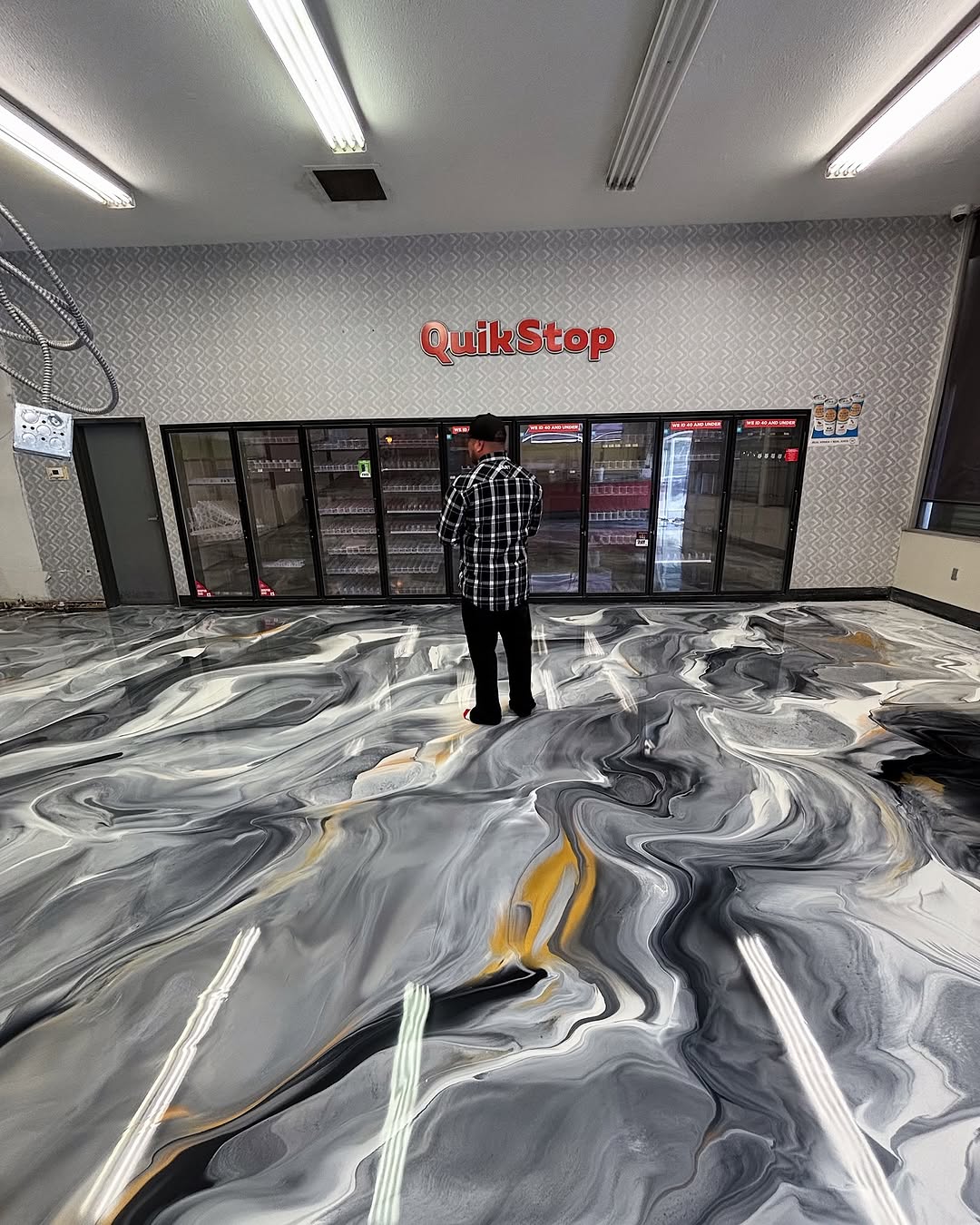
Most of these buildings end up with more than one system under one roof. A sales floor might get a decorative finish while the storage room behind it takes a flake broadcast with a tougher topcoat. We would rather price that honestly as two specs than stretch one product across both rooms and watch the weaker one fail first.
Size works in your favor here. A small room can be ground, coated and sealed in a short window, which makes it far easier to fit the work around a business that cannot afford to be dark for long.
Four floors a golf community leans on
These rooms come up again and again around a golf community, and no two of them want the same floor.
Clubhouse service rooms
Prep rooms, dish areas and back hallways behind a dining space. The coating runs up the wall as a coved base so water has no corner to sit in, and the topcoat carries texture wherever the floor stays wet during a shift.
Pro-shop style retail
Display floors where the surface is part of the sale. Flake or metallic depending on the look you want, laid after closing so the doors open on schedule, with a clear that holds up to wet shoes and dragged fixtures.
Cart barns and storage
Long bays where carts roll in wet, sit overnight and roll back out. Full-broadcast flake gives traction and hides tire marks, and the joints are filled flexible so the slab can move without splitting the coating.
Maintenance shops
Workbenches, mowers, equipment and the occasional oil drip. Thickness counts for more than color here, and safety lines get inlaid into the coating so they last as long as the floor does.
Washdown, slip resistance and the cove
Any room cleaned with a hose has to be designed around standing water. Two details matter most. The first is the base. A coved base carries the coating up the wall in a smooth curve, which removes the square corner where water, food and dirt collect, and which is exactly where an inspector looks first.
The second is texture, and it is a balance. Too smooth and a wet floor turns dangerous. Too rough and it holds dirt and fights the mop. We tune it with aggregate in the final coat, heavier near sinks and drains and lighter in the aisles, so staff get grip where they need it and the floor still cleans in one pass.
Rooms that take hot water and harsh cleaners every day are usually the wrong place for standard epoxy. Urethane cement handles that thermal shock and chemistry far better. A single building can carry both, with the break between them landing at a doorway.
The joint where floor meets wall is where most commercial coatings start to let go. Coving it takes that weak spot away entirely.
Nights, weekends and phased floors
A shop that serves golfers cannot close on a Saturday morning, and a service room behind a dining space cannot sit out a busy weekend. So commercial work in Ridgemark mostly happens after close. Fast-cure systems take foot traffic within hours, and a single small room is often done in one night.
Bigger floors get split into phases. One section stays usable while the other cures, and we put the stopping point at a threshold or behind shelving where the seam will never draw an eye.
Moisture gets checked before any of that goes on the calendar. Buildings set into the foothills can take water against a slab from the uphill side, so one end of a floor may read wetter than the other. Johnny runs a calcium chloride test on the slab itself. If the reading is high, a moisture-mitigating primer is in the written price from day one, where you can see it.
Control joints are handled as joints. They are filled with a flexible material and carried through the finished surface, because a coating bridged over a joint that is still moving will split right along it with the next change in weather.
Old coatings come up before new ones go down. Many small commercial floors carry a painted finish or a sealer from a past owner, and anything that is not bonded tightly will take the new system with it when it lets go. The grinder removes it down to sound concrete, and Johnny shows you what the slab looks like underneath before the first coat is mixed, so any patching gets discussed with the floor open in front of you.
For shops and heavier equipment rooms, the full picture is on our industrial coatings page.
Questions from Ridgemark business owners
Can you coat our floor without closing the business?
In most cases, yes. We work after closing or across a weekend and use fast-cure systems that take foot traffic within hours. A small room usually takes one night. Larger spaces are phased so part of the floor stays in use. Tell us your hours and your busiest days at the site assessment.
What kind of floor works in a room we hose down every day?
One with a coved base, texture in the topcoat and chemistry matched to your cleaners. Standard epoxy copes well with ordinary mopping, but daily hot water and strong degreasers usually point to urethane cement instead. We ask what you clean with before recommending anything, since that answer decides the system.
Our cart barn floor is stained and cracked. Is it worth coating?
Stains are rarely the obstacle, because the diamond grind removes the contaminated top layer. Cracks depend on whether they are still moving. Static cracks get filled and vanish under the coating. Active ones mean the slab is shifting, and we will point that out instead of hiding them for a season.
Do you check the slab for moisture before starting?
Every time. Buildings set into the foothills can pick up water from higher ground, so Johnny runs a calcium chloride test on the actual slab. A high reading means a moisture-mitigating primer, and it appears in the written price before work begins, so the cost does not change halfway through the job.
Can walkways and cart lanes be marked into the floor?
Yes. Walkways, cart parking lines and hazard zones are inlaid into the coating instead of painted on after it cures. Because inlaid lines sit beneath the clear topcoat, they wear along with the floor and do not flake away where carts and equipment cross them day after day.
Can you supply paperwork for a landlord or a community board?
Yes. We are JP Resin and Don Resin certified and can provide insurance documentation for a landlord, a property manager or a board. Mention it at the site assessment and the paperwork arrives together with your written price, so nobody has to chase it once the job is on the calendar.
Book a commercial site assessment
Send the rough size of the space, what crosses the floor on a normal day and how it gets cleaned. Johnny walks the room with you, reads the slab for moisture and puts a price in writing, with any repair work on its own line so prep and finish are easy to tell apart.
Finished commercial and residential floors are in the gallery. Rather write it down? Send Johnny the details and he will follow up.